
Advantages and Disadvantages of Essential Oils for Private Label

The demand for natural ingredients has never been higher. If you look at the shelves of any major retailer, you will see labels shouting about plant-based power. Whether it is skincare, haircare, or wellness products, essential oils are at the center of this movement.
For a business, this is a huge opportunity. Private-label brands and OEM manufacturers are rushing to include essential oils in their formulas. But here is the truth: essential oils are powerful. Because they are powerful, they come with both big benefits and real risks.
If you are a sourcing manager or a brand owner, you cannot just pick an oil because it smells nice. You need to understand the "pro and con" list from a business perspective. You need to know how an oil will behave in a cream, how it will affect your packaging, and if it will pass safety tests in different countries.
This blog is designed for the B2B buyer. We are going to look at the advantages and disadvantages of essential oils honestly. We will explain how you can use this knowledge to design a better product line. By the end, you will have a clear idea of how to build a successful brand using these natural extracts, and why choosing the right manufacturing partner is the most important step.
What Essential Oils Are
Before we talk about business strategy, we need to be clear about what we are handling. Essential oils are not actually "oils" in the way olive oil is. They are concentrated plant extracts.
- How they are extracted: Most essential oils are made through steam distillation. Imagine a large vat filled with peppermint leaves. Steam is pushed through the leaves, which pulls the aromatic compounds out. That steam is then cooled down until it turns back into liquid. The "essential oil" floats on top.
Some oils, like orange or lemon, are "cold-pressed." This means the peel is squeezed until the oil comes out. It is a physical process, not a chemical one.
- Why they are concentrated: It takes a lot of plants to make a tiny bit of oil. For example, it can take thousands of rose petals to make just a few drops of Rose essential oil. This is why they are so expensive and so strong. One drop is often equivalent to dozens of cups of herbal tea.
- Basic safety facts: Because they are so concentrated, they are chemically active. They are not "harmless" just because they are natural. If you put pure essential oil on your skin, it can burn. In manufacturing, we always talk about "dilution." This is the practice of mixing a small amount of essential oil into a large amount of "carrier" (like water, oil, or cream).
- Why brands use them: Brands use them because they offer a "clean label" solution. Instead of using a synthetic perfume made in a lab, you can use an extract from a real plant. This tells a story that customers love to hear.
What Are Essential Oils? A Complete Guide for Beginners
Advantages of Essential Oils
From a business standpoint, essential oils offer several "wins." If you are building a private-label line, these are the reasons to include them.
- Natural aroma for products - Most consumers are moving away from "fragrance" or "parfum" on an ingredient list. They want to see the name of a plant. Essential oils provide a complex, beautiful scent that synthetic scents often struggle to match. A lavender-scented cream made with real oil smells "expensive" compared to a cheap synthetic version.
- Skin and wellness properties - Essential oils are not just for smell. They have functional benefits. Tea tree oil is famous for its ability to clean the skin. Rosemary oil is trending globally for its ability to support the scalp. When you use these oils, you aren't just making the product smell good; you are making it work better.
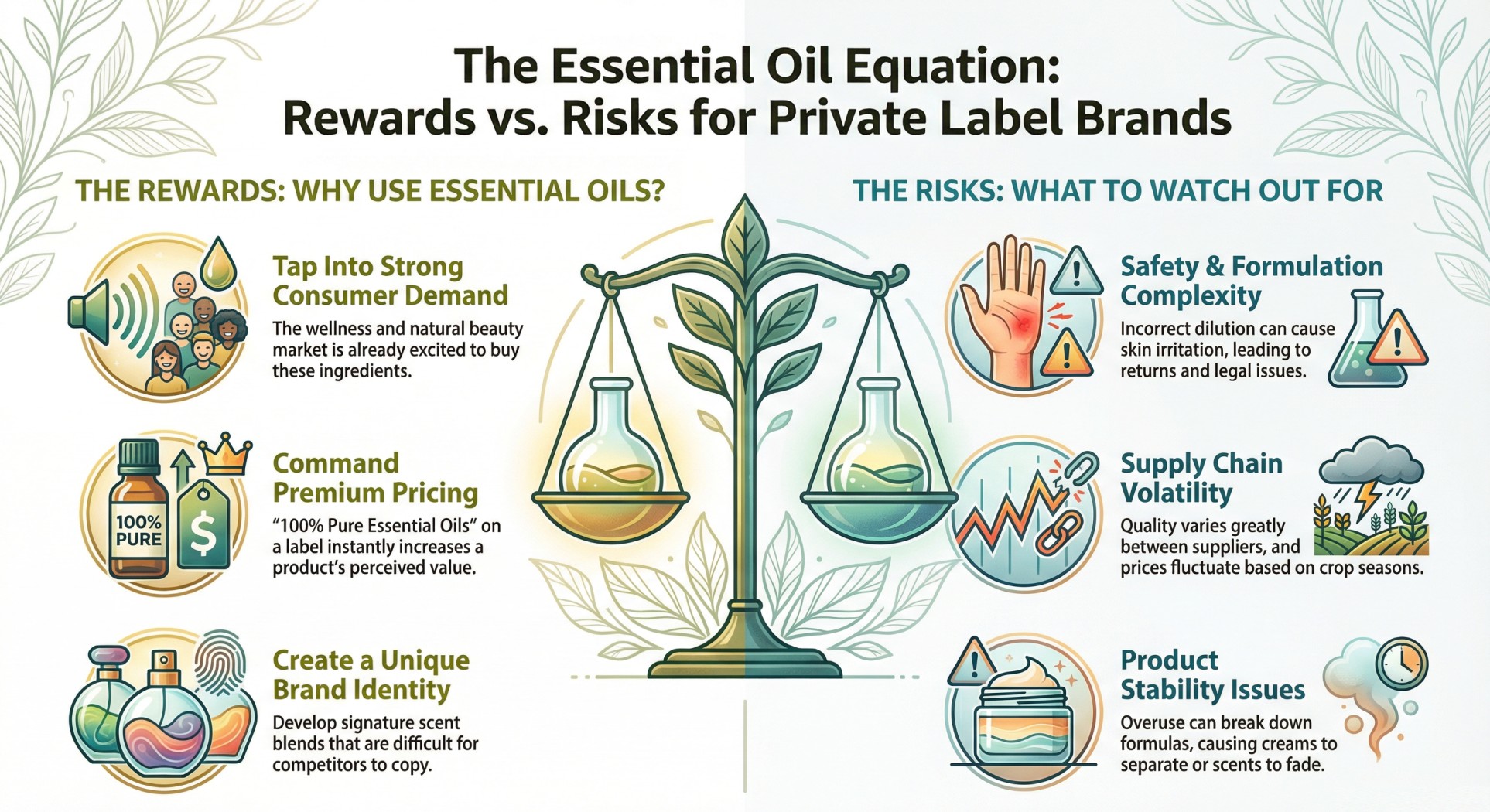
- Strong consumer demand - The "Wellness" market is growing every year. People are looking for aromatherapy, stress relief, and natural healing. By using essential oils, you are tapping into a market that is already excited to buy. You don't have to convince people that lavender is relaxing; they already know it.
- Fits clean-label trends - If you want to sell your products in "Green" or "Organic" stores, you usually cannot use synthetic fragrances. Essential oils allow you to keep your formula "clean." This opens up more retail opportunities and builds trust with your audience.
- Easy to blend with carrier oils - Essential oils mix very well with other natural fats like almond oil or jojoba oil. This makes it easy to create simple, effective products like beard oils, massage oils, or face serums. You don't need complex chemistry to make a high-quality oil blend.
- Works for many formats - One oil can be used in ten different products. You can put peppermint oil in a shampoo, a foot cream, a lip balm, and a room spray. This flexibility is great for B2B buyers because it allows you to buy in bulk and use the ingredient across your whole range.
- Long shelf life when stored well - Pure essential oils don't contain water. Because of this, they don't grow mold or bacteria easily. If you keep them in a cool, dark place, many oils can last for two or three years. This makes inventory management much easier for a manufacturer.
- Helps brands create signature blends - You can mix different oils to create a scent that belongs only to your brand. This "signature scent" becomes part of your brand identity. It is much harder for a competitor to copy a complex blend of five essential oils than it is to copy a single synthetic scent.
- Supports premium pricing - Customers are willing to pay more for a product that contains "100% Pure Essential Oils." It moves your brand from the "budget" category to the "premium" category. The perceived value of the product goes up instantly.
7 Hidden Benefits of Essential Oils You Haven't Tried Yet
Disadvantages of Essential Oils
We believe in being honest. While essential oils are great, they come with challenges that a business must manage.
- Can irritate skin if not diluted - This is the biggest risk. If your formula has too much essential oil, it can cause a rash or an allergic reaction for the customer. This leads to returns, bad reviews, and even legal issues. You must have a skilled formulator who understands safe "usage rates."
- Quality varies across suppliers - Not all lavender is the same. Some suppliers "cut" their oils with cheaper chemicals to save money. If you buy a low-quality oil, your whole product line suffers. You need a supplier who provides lab tests to prove purity.
- Overuse can harm formula stability - Essential oils are "solvents." This means they can break down other ingredients. If you add too much oil to a thick cream, it might cause the cream to separate and turn into a liquid mess. Finding the balance between "smell" and "stability" is a technical challenge.
- Strong odor may not suit every product - Some essential oils, like Neem or Tea Tree, have very strong, medicinal smells. While they are healthy, some customers might find them unpleasant. You have to learn how to "mask" these smells with other oils, which adds complexity to your formula.
- Seasonal price changes - Because these oils come from crops, the price can change. If there is a drought in a country that produces Lemon oil, the price will go up. This can make it hard to keep your product prices consistent.
- Some oils oxidize quickly - Citrus oils (like Orange, Lemon, and Grapefruit) are very sensitive to air. If they are exposed to oxygen, they lose their smell and can become irritating to the skin. This means your manufacturing and packaging must be very airtight.
- Regulation rules vary by region - What is legal in India might have different rules in the European Union or the USA. For example, some oils are restricted in leave-on products but allowed in soaps. If you want to export your brand, you need to navigate these complex rules.
- Need skilled formulators for safe blends - You cannot just "guess" how much oil to use. You need to follow IFRA (International Fragrance Association) guidelines. This requires professional R&D (Research and Development) support, which can be an extra cost for a small brand.
B2B Interpretation: What This Means for Your Private-Label Line
Now that we know the pros and cons, how do you make a business decision?
- When to choose essential oils over synthetic fragrances - If your brand story is about "Luxury," "Health," or "Nature," you should choose essential oils. If you are making a budget product where the only goal is to smell like "Bubblegum" or "New Car," synthetic fragrances are easier and cheaper. But for skincare that actually works, essential oils are the better investment.
- How to pick oils based on your market
- Skincare: Focus on "gentle" oils like Rose Geranium or Frankincense.
- Spa & Wellness: Go for "mood" oils like Eucalyptus (energy) or Lavender (sleep).
- Haircare: Use "functional" oils like Rosemary (growth) or Peppermint (scalp health).
- How to keep formulas stable - Work with a manufacturer who performs "stability testing." This is a process where they put the product in a hot oven for weeks to simulate a year on a shelf. This ensures the essential oils won't ruin the texture of your cream over time.
- Choosing oils based on IFRA safety limits - Every oil has a "safe limit." For example, some citrus oils can make skin sensitive to sunlight if used in high amounts. A good partner like AG Organica will ensure your formula stays below these limits so you never have to worry about safety recalls.
- Budget-friendly vs. Premium lines
- Budget: Use oils like Lemongrass, Orange, or Citronella. They are effective but affordable.
- Premium: Use oils like Sandalwood, Jasmine, or Neroli. These are expensive, but they allow you to charge a much higher price for the finished product.
- Why working with a manufacturer reduces risk - When you work with a contract manufacturer, they take on the technical burden. They handle the sourcing, the safety checks, and the stability testing. Instead of buying ten different oils and trying to mix them in your garage, you get a finished, tested product that is ready to sell.
Private Label Essential Oils Manufacturer | Bottled & Labeled
White-Label Product Line Ideas Using Essential Oils
If you are looking for ideas for your next launch, here are some concepts that are currently performing well in the market.
- Skincare Ideas
- Tea Tree Face Gel: A simple, clear gel for oily and acne-prone skin. It is popular with teenagers and young adults.
- Rose Geranium Toner: A floral water (hydrosol) mixed with Rose Geranium oil. It smells like a garden and feels very refreshing.
- Lavender Night Cream: A thick, rich cream designed to be used before bed. The lavender helps the customer relax while the cream hydrates their skin.
- Haircare Ideas
- Rosemary Hair Oil: This is currently one of the most searched hair products globally. It is used to massage the scalp to support thicker hair.
- Lemongrass Anti-Dandruff Shampoo: Lemongrass is a natural cleanser. Combined with a gentle shampoo base, it helps keep the scalp clear and smells very fresh.
- Peppermint Scalp Serum: A lightweight, watery serum that gives a cooling "tingle." It is great for people with itchy or dry scalps.
- Wellness Ideas
- Essential Oil Roll-Ons: Small glass bottles with a rollerball. You can have a "Focus" roll-on (Lemon & Rosemary) or a "Calm" roll-on (Lavender & Cedarwood).
- Diffuser Blends: Bottles of pure oil blends meant for home diffusers. These are great for "Home Decor" or "Gift" brands.
- Stress Relief Kits: A boxed set containing a bath oil, a roll-on, and a small candle, all using the same calming essential oils.
- Body Care Ideas
- Citrus Shower Gel: A mix of Orange, Lemon, and Grapefruit oils. It is "sunshine in a bottle" and perfect for a morning shower.
- Eucalyptus Bath Salt: Epsom salts mixed with eucalyptus oil. This is a classic product for muscle recovery and spa-at-home vibes.
- Coffee & Orange Body Scrub: A mix of coffee grounds, sugar, and orange essential oil. The scent is addictive and the oil helps soften the skin after scrubbing.
Packaging Trends for Essential Oil Products (2025–2026)
The way you package your oil products is just as important as the formula itself. In 2026, the trend is "Functional Beauty."
- Amber and cobalt glass: Essential oils are destroyed by light. If you put them in a clear bottle, they will go bad in weeks. Amber (brown) or cobalt (blue) glass blocks the light. It also looks "traditional" and "apothecary-style," which customers trust.
- Matte labels for a premium look: Glossy, shiny labels can look cheap. Matte (non-shiny) labels feel better in the hand and look more expensive. Using "soft-touch" paper makes the customer feel like they are holding a luxury item.
- Minimal, clean design: Don't clutter your label with too many pictures. A clean design with clear text tells the customer that the product is professional. In 2026, "less is more."
- QR codes with transparency data: Today’s buyers are smart. They want to see the "roots" of the product. Putting a QR code on the label that links to a "Purity Report" or a video of the harvest builds massive trust.
- Sustainable options: People who buy natural oils usually care about the planet. Using bamboo caps instead of plastic, or using 100% recycled glass, can be a major selling point for your brand.
- Travel-friendly small sizes: Wellness is now portable. People want to take their "calm" with them. Small 5ml or 10ml bottles are very popular as "travel essentials."
- Pump and dropper formats: For face oils, a glass dropper is best because it feels like a treatment. For body oils or shampoos, a pump is better because it is easier to use in the shower. Making sure your "dispensing system" matches the product use is key to a good user experience.
Classification of Essential Oils
Comparison Chart: AG Organica vs. Other Suppliers
Choosing a manufacturing partner is a long-term decision. Here is how we compare to a typical "bulk supplier."
|
Feature |
AG Organica |
Typical Supplier |
|
In-house extraction |
Yes |
No (They buy and resell) |
|
Custom formulation |
Yes |
Limited or None |
|
IFRA-safe blends |
Yes |
Not always guaranteed |
|
Packaging options |
Wide range (Custom) |
Basic / Stock only |
|
Lab testing |
In-house (GC-MS) |
Often Outsourced |
|
MOQ flexibility |
Flexible for growing brands |
Usually very strict |
|
Export experience |
Strong (Global reach) |
Mixed / Local only |
|
White-label ready |
Yes (End-to-end) |
Not fully supported |
Pure vs. Organic Essential Oils: What's the Difference?
How OEM/ODM and Private-Label Buyers Should Choose Oils
If you are evaluating an oil or a supplier, use this simple checklist.
- Check Purity: Does the oil smell "flat" or "chemical"? A pure oil should have a complex, deep aroma.
- Ask for COA and MSDS: These are the legal birth certificates of the oil. If a supplier cannot provide a Certificate of Analysis (COA) and a Material Safety Data Sheet (MSDS), walk away.
- Confirm IFRA Compliance: Ask the manufacturer if the blend is safe for the specific category you are selling in (e.g., a face cream vs. a candle).
- Verify Country of Origin: Lavender from France is different from Lavender from Bulgaria. Know where your plants are coming from.
- Test Small Batches: Before you order 10,000 units, do a small run. See how the product smells after a month on the shelf.
- Review Aroma Strength: Some oils are very light; others are overwhelming. Make sure the "scent load" is right for your customer.
- Confirm Packaging Compatibility: Make sure your bottle and cap won't be melted or damaged by the essential oil. (Some oils can "eat" certain plastics).
Why Work With AG Organica
At AG Organica, we don't just sell oil. We build brands. We understand the B2B landscape and the challenges you face when bringing a new product to market.
- Large range of essential oils: We offer everything from common favorites like Lemon and Lavender to rare extracts. Because we handle large volumes, we can offer competitive pricing that helps your profit margins.
- Skilled R&D team: Our chemists are experts in natural products. They know how to make a cream that feels amazing while still containing high levels of active essential oils. They take the "guesswork" out of formulation.
- Custom blends: Do you want a "Signature Scent" that no one else has? We can work with you to create a unique blend that defines your brand.
- Global export support: We ship products all over the world. We know the paperwork needed for different customs offices. This makes it much easier for you to scale your brand globally.
- Strong quality control: We have an in-house laboratory. Every batch of oil is tested using GC-MS (Gas Chromatography-Mass Spectrometry). This ensures that the oil is 100% pure and exactly what the label says it is.
- End-to-end private-label service: We can take you from "Idea" to "Finished Product." We handle the sourcing, formulating, bottling, labeling, and testing. You get a box of products ready to be shipped to your customers.
FAQ Section
- Are essential oils safe for skincare? Yes, they are safe when used at the correct dilution. Most face products use between 0.5% and 1% essential oil. When formulated correctly, they provide great benefits without irritation.
- What is the best dilution level? It depends on the product. For a "rinse-off" product like soap, you can use more. For a "leave-on" product like an eye cream, you must use very little. A professional manufacturer will handle these calculations for you.
- Which oils are most stable in creams? Oils like Cedarwood, Sandalwood, and Patchouli are very stable "base notes." They help hold the scent for a long time. Citrus oils are the least stable and need careful formulation to stay fresh.
- Can I create my own signature blend? Absolutely. We encourage this. A signature blend makes your brand unique. You can work with our team to find the perfect mix of "top, middle, and base notes."
- What packaging works best for essential oils? Glass is always the best choice, especially dark glass. If you must use plastic, it needs to be a specific type (like PET or HDPE) that is resistant to essential oils.
Conclusion
Essential oils are a powerful tool for any beauty or wellness brand. They offer the natural aroma and functional benefits that modern customers are looking for. However, they are not "plug-and-play" ingredients. They require respect, technical knowledge, and careful sourcing.
The "advantage" of using essential oils is that you create a high-value, premium brand with a loyal following. The "disadvantage" is the technical complexity of making them safe and stable.
By choosing a partner like AG Organica, you get all the benefits without the headaches. We provide purity, lab testing, and manufacturing expertise so you can focus on growing your business. Whether you are looking for a bulk supply of pure oils or a full-service private-label partner, we are here to help.
The market for natural, plant-based products is only going to grow. Now is the perfect time to build a brand that is grounded in nature and backed by science.