
Cold-Pressed vs. Refined Pumpkin Seed Oil

Pumpkin seed oil is popular because it is rich in zinc and vitamins. Cold-pressed oil is natural and dark, while refined oil is clear and shelf-stable. Brands choose cold-pressed for high-end luxury serums and refined for large-scale food production. Knowing the difference helps procurement teams manage costs and ensure product quality for their customers.
Introduction
In 2026, the demand for pumpkin seed oil is growing across many industries. Beauty brands want it for its high zinc and vitamin E content. Food companies want it for its heart-healthy fats. Supplement makers use it to support prostate and bladder health. As interest grows, so does the volume of bulk orders.
However, many buyers face a big challenge when looking at sourcing options. They see two main types: cold-pressed and refined. These two grades look, smell, and perform very differently. Choosing the wrong one can lead to ruined batches, short shelf life, or high costs.
This guide explains the facts about both grades. We will look at how they are made and why the extraction method changes the final product. We will also help you decide which one fits your specific formulation and budget.
What Cold-Pressed Pumpkin Seed Oil
Cold-pressed pumpkin seed oil is the most natural form of the oil. It is made by taking raw or slightly dried seeds and putting them through a mechanical press. The temperature during this process is kept very low, usually below 50°C.
Because the temperature is low, the natural chemistry of the seed stays the same. The vitamins, antioxidants, and minerals are not damaged by heat. This results in an oil that is very high in nutrients. It is often described as "virgin" or "unrefined" oil.
The oil has a very distinct look and smell. It is usually a deep, dark green or a brownish-red color. The aroma is very nutty and strong. In 2026, this "raw" quality is what high-end beauty brands look for because it feels authentic to the customer.
However, cold-pressing has some limits for the supplier. The extraction yield is lower compared to other methods. You get less oil from the same amount of seeds. This makes the cost per liter higher. For bulk buyers, this also means the minimum order quantities (MOQs) might be more strict.
What Refined Pumpkin Seed Oil
Refined pumpkin seed oil is processed to make it more consistent and stable. After the initial extraction, the oil goes through several steps. These steps include filtering, bleaching, and deodorizing.
High temperatures are often used during refining. This process removes the strong "nutty" smell and the dark green color. What remains is a pale yellow oil with almost no scent. It is much lighter than the cold-pressed version.
Refining is done to increase the extraction efficiency. Manufacturers can get more oil out of the seeds using heat or solvents. This brings the price down for the bulk buyer. It also makes the oil much more stable for long-term storage.
Refined oil is preferred when the brand does not want the pumpkin scent to interfere with other fragrances. It is also better for products that need a long shelf life, like mass-market food items or clear skincare serums. It is a reliable choice for large-scale manufacturing where consistency is the most important factor.
Side-by-Side Sourcing Comparison
When you are sourcing in bulk, you need to look at more than just the price. Here is how the two grades compare across different factors.
- Purity: Cold-pressed oil is the pure "juice" of the seed. It contains nothing but the oil and the natural nutrients. Refined oil is also pure in terms of being 100% pumpkin seed oil, but it has lost the "extra" plant compounds during the cleaning process.2
- Extraction Efficiency: Refined oil is much more efficient to produce. This means the supply is often more stable. If a harvest is small, refined oil is easier to find in large quantities than cold-pressed oil.
- Shelf Life: Refined oil wins on shelf life. Because the natural "impurities" (which are actually nutrients) are removed, there is less for oxygen to react with. Cold-pressed oil is more sensitive and can go rancid faster if not stored perfectly.3
- Color and Odor Consistency: Cold-pressed oil can change slightly from batch to batch. The color might be darker one month and lighter the next. Refined oil is almost always exactly the same. This is a big deal for brands that want their products to look identical on every shelf.
- Heat Stability: If you are making a product that requires heat during manufacturing, refined oil is safer. Cold-pressed oil has a lower smoke point.4 If it gets too hot, the nutrients break down and the smell can become unpleasant.
- Export Documentation: Both grades require strict paperwork for international shipping. However, refined oil is often easier to clear through customs in some countries because it is seen as a "standard" processed ingredient. Cold-pressed oil may require more proof of its "virgin" status.
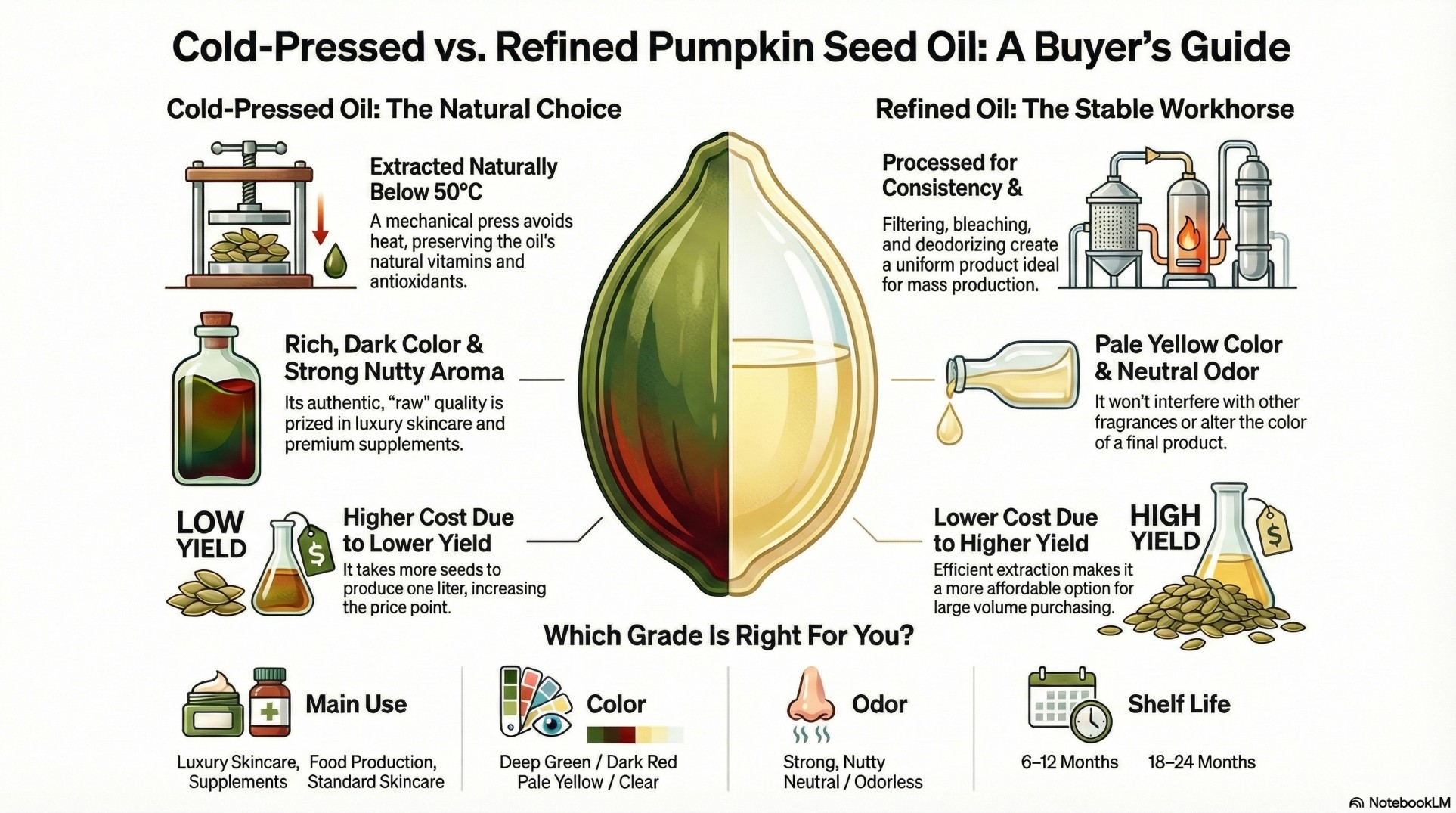
Comparison Chart: AG Organica Perspective
At AG Organica, we maintain high standards for both grades. Here is how we differentiate them for our bulk partners.
|
Feature |
Cold-Pressed Oil |
Refined Oil |
AG Organica Note |
|
Purity |
100% natural, nutrient-rich |
Processed for stability |
We test both for 0% adulteration. |
|
Extraction |
Below 50°C |
High heat + filtering |
Our units use clean, modern tech. |
|
Color |
Deep green / Dark red |
Pale yellow / Clear |
Cold-pressed is highly pigmented. |
|
Odor |
Strong, nutty, toasted |
Neutral / Odorless |
Refined is best for scented products. |
|
Shelf Life |
6–12 months |
18–24 months |
We use nitrogen flushing for both. |
|
Yield |
Lower (Higher cost) |
Higher (Lower cost) |
Bulk prices fluctuate with harvest. |
|
Main Use |
Luxury skincare, Supplements |
Food, Standard skincare |
We help you choose the right one. |
Which Grade Works Best for Your Use Case?
Deciding which oil to buy depends on your final product. Procurement managers should follow these general rules for 2026 trends.
- For Skincare and Nutraceuticals: If you are making a "premium" face oil or a hair growth serum, choose cold-pressed. The zinc and vitamin E are essential for the product to work. For health supplements in softgel form, cold-pressed is also the standard. Customers pay more for the "raw" benefits.
- For Large-Scale Food Manufacturing: If you are making salad dressings or health foods for supermarkets, refined oil is often better. It is more affordable and has a neutral taste that won't overpower the food. It also stays fresh on the grocery shelf for a longer time.
- For Stable Formulations: If your product has a complex formula with many ingredients, refined oil is easier to work with. It doesn't react as much with other chemicals. It also won't change the color of your cream or lotion.
- For Products Needing Natural Aroma: If you want your product to smell like "nature" without adding perfumes, use cold-pressed. The nutty, rich scent is very popular in organic and vegan markets right now.
- For Export Buyers: If you are shipping to many different countries, refined oil is often the safer bet for logistics. It handles temperature changes during shipping much better than cold-pressed oil.
Cost Breakdown for Bulk Buyers
Price is a major factor in bulk procurement. You need to understand why the costs differ so you can explain it to your finance team.
- Why cold-pressed is costlier - It takes more seeds to make one liter of cold-pressed oil. The machines also run slower to keep the temperature low. Because the oil contains more nutrients, it is also more expensive to test and certify. You are paying for the quality of the "living" nutrients.
- How refining reduces cost - Refining allows the manufacturer to extract almost every drop of oil from the seed. This high yield means the price per kilogram is lower. Because it is more stable, there is also less waste during the manufacturing process.
- Hidden costs to watch for - Choosing only by price is risky. A "cheap" cold-pressed oil might be old or mixed with other oils. If the oil goes rancid in your warehouse, you lose the entire investment. Refined oil might seem cheaper, but if your customers want "natural," they won't buy a product made with refined ingredients.
Always look at the total value, including the cost of shipping and the risk of spoilage. At AG Organica, we provide transparent pricing so you know exactly what you are paying for in terms of grade and quality.
Shelf Life, Storage, and Stability
Managing the shelf life of your oil is critical for your production cycle.
- Cold-Pressed Stability: Cold-pressed oil contains natural antioxidants like tocopherols.5 These help protect the oil for a while. However, it is very sensitive to light and air. Once you open a bulk drum, you must use it quickly. We recommend using it within 6 to 12 months of production.
- Refined Stability: Refined oil is "rugged." It has been stripped of the parts that break down easily. It can handle being in a warehouse for 18 to 24 months without losing its quality. This makes it a great choice for brands that buy in very large volumes and store inventory for a long time.
- Storage Rules: Both oils should be stored in a cool, dark place. For bulk buyers, this means a climate-controlled warehouse is best. Keep the drums sealed tight. If possible, use nitrogen blankets to push out the oxygen inside the drum. This significantly extends the life of the oil.
Quality Checks Procurement Teams Should Always Request
Never take a supplier’s word for quality. In 2026, you must demand specific tests for every batch of pumpkin seed oil.
- GC/MS (Gas Chromatography-Mass Spectrometry): This test shows the fatty acid profile. It proves the oil is actually from pumpkin seeds and hasn't been diluted with cheaper oils like sunflower or soy.
- Acid Value: This measures the amount of free fatty acids. A high acid value means the oil is starting to break down. For high-quality cold-pressed oil, this should be very low.
- Peroxide Value: This is the most important test for freshness. It measures early oxidation. If this number is high, the oil will go rancid very soon.
- Microbial Test: This ensures there are no bacteria or mold in the oil. This is mandatory if you are using the oil in food or skincare.
- Certificate of Analysis (CoA): Every shipment must have a CoA. This is the "birth certificate" of the oil. It lists all the test results for that specific batch. If a supplier cannot provide this, do not buy from them.
Mistakes Bulk Buyers Commonly Make
Even experienced procurement managers make mistakes. Here are a few to avoid.
- Choosing based only on color: Some buyers think a darker green means better quality. This is not always true. Color can depend on the type of pumpkin seed used (like the Styrian variety). Always look at the lab results, not just the appearance.
- Ignoring batch consistency: If you buy cold-pressed oil, you must expect slight changes between batches. If your formulation cannot handle a change in scent or color, you should switch to refined oil. Do not expect refined-level consistency from a cold-pressed product.
- Assuming refined means "low quality": Refined oil is a high-quality tool for the right job. It is not "fake" oil. It is just processed for a specific use. Using cold-pressed oil in a product that will be heated to 200°C is a waste of money; refined would be the better choice.
- Not checking storage conditions: Ask your supplier how they store their bulk drums. If the oil sits in a hot warehouse before it reaches you, the shelf life is already being reduced.
Why AG Organica Is a Reliable Source
AG Organica is a trusted partner for global brands because we focus on the facts of manufacturing. We do not use hype; we use science.
- Control Over Seeds - We source high-quality seeds from trusted farmers. We know where the seeds come from and how they were grown. This is the first step in ensuring a pure final product.
- Clean Extraction Units - Our factory is equipped with modern cold-pressing and refining equipment. We maintain strict hygiene standards to prevent contamination at every stage of the process.
- Testing at Every Stage - We don't just test the final product. We test the seeds and the oil during processing. Our in-house lab ensures that every drum meets international standards for purity and safety.
- Bulk Supply and Export Experience - We are built for scale. Whether you need one drum or a full container, we can handle the volume. We also understand the complex rules for exporting to the USA, Europe, and Asia. We provide all the necessary paperwork, including MSDS and CoA, to make your job easier.
Conclusion
In 2026, the choice between cold-pressed and refined pumpkin seed oil is about more than just price. It is about matching the ingredient to your brand's promise.
If your brand is built on "pure nature" and "maximum nutrients," cold-pressed is the right choice. It offers the dark color and rich scent that customers love. If your brand is built on "consistency," "large-scale value," or "stable formulas," refined oil is the better tool.
Both grades are useful in their own way. The right choice depends on your purity needs, your cost limits, and your specific formulation requirements.
AG Organica is here to help you make that choice. We provide both grades with the same high level of testing and reliability.