
6 Essential Oil Groups, Properties & Industrial Uses

A.G. Organica Pvt Ltd is a global leader in the bulk manufacturing and export of high-purity essential oils. We provide industrial-grade botanical extracts for the cosmetics, pharmaceutical, food, and home-care sectors, ensuring consistent quality and GC/MS-verified purity for global brand scaling.
Guide to 6 Essential Oil Groups, Their Properties, Aromas & Industrial Uses
In the global manufacturing landscape, essential oils have evolved far beyond their traditional roots in aromatherapy. Today, they serve as multifunctional raw materials—acting as natural preservatives, active pharmaceutical ingredients, sensory enhancers, and odor-neutralizers across a multi-billion-dollar industrial spectrum.
For cosmetic formulators, home-care product developers, and pharmaceutical manufacturers, understanding the classification of these oils is not just a botanical exercise; it is a prerequisite for successful product development. Essential oils are generally categorized into six primary groups based on their plant source, chemical architecture, and dominant aromatic profiles.
This guide provides a technical and commercial deep dive into these six groups, exploring their industrial utility and the formulation value they offer to global B2B buyers.
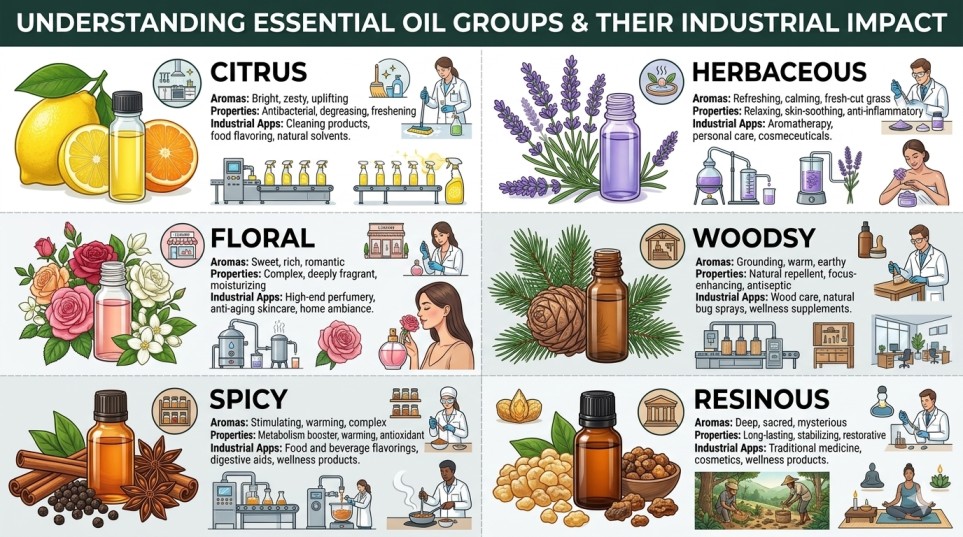
What Are Essential Oil Groups?
What are the primary essential oil groups used in manufacturing?
Essential oil groups are technical classifications—Woods & Resins, Leaves, Flowers, Spices, Roots, and Fruits—categorized by their botanical origin and chemical composition. These groups help industrial formulators select ingredients based on aroma volatility (notes), formulation stability, and functional properties. Grouping allows manufacturers to streamline sourcing for specific applications like antimicrobial cleaning agents (Leaves), premium fragrance fixatives (Woods/Roots), or uplifting top-notes in skincare (Fruits).
-
Group – Woods & Resins Essential Oils
Wood and resin-derived oils are the "architects" of the fragrance world. Extracted from the heartwood, bark, or sap of trees, these oils are characterized by high molecular weight and low volatility.
Aroma Profile
- Characteristics: Warm, woody, balsamic, earthy, and grounding.
- Volatility: Slow evaporation; these typically function as Base Notes.
Common Oils
- Sandalwood (Santalum album)
- Frankincense (Boswellia carterii)
- Cedarwood (Cedrus atlantica)
- Myrrh (Commiphora myrrha)
Industrial Uses & Functional Properties
- Cosmetics & Anti-Aging: These oils possess natural skin-conditioning properties. Sandalwood and Frankincense are staples in luxury anti-aging serums for their perceived ability to support skin elasticity.
- Perfumery (Fixatives): Woody oils are used as fixatives to "hold" lighter floral or citrus scents, preventing them from evaporating too quickly.
- Home Fragrance: Dominant in the luxury candle and incense markets due to their rich, long-lasting scent throw.
-
Group – Leaf Essential Oils
Leaf oils are the workhorses of the functional personal care and home-care industries. They are often high in cineole, menthol, or terpenes, providing a sharp "cleansing" sensory experience.
Aroma Profile
- Characteristics: Green, fresh, medicinal, camphoraceous, and sharp.
- Volatility: Moderate to fast; functioning as Top-to-Middle Notes.
Common Oils
- Eucalyptus (Eucalyptus globulus)
- Tea Tree (Melaleuca alternifolia)
- Peppermint (Mentha piperita)
- Rosemary (Rosmarinus officinalis)
Industrial Uses & Functional Properties
- Cleaning & Disinfectants: Leaf oils like Tea Tree and Eucalyptus are prized for their antimicrobial and antifungal properties, making them essential for "green" floor cleaners and laundry detergents.
- Oral Care: Peppermint and Spearmint are the global standards for flavoring toothpaste and mouthwash due to their cooling sensation.
- Pharmaceuticals: Widely used in decongestant balms, vapor rubs, and topical analgesic formulations.
-
Group – Flower Essential Oils
Flower oils represent the highest value tier in the essential oil market. The low yield of oil from delicate petals drives premium pricing and high consumer desirability.
Aroma Profile
- Characteristics: Floral, sweet, soft, powdery, and luxurious.
- Volatility: Middle notes; providing the "heart" of a fragrance.
Common Oils
- Lavender (Lavandula angustifolia)
- Rose (Rosa damascena)
- Jasmine (Jasminum officinale)
- Geranium (Pelargonium graveolens)
Industrial Uses & Functional Properties
- Premium Beauty: Essential for facial oils and night creams targeting "emotional wellness" and skin soothing.
- Fine Fragrance: Flower oils provide the core identity for most feminine and unisex perfumes.
- Wellness & Spa: Lavender remains the most exported oil globally for the aromatherapy and relaxation sectors.
-
Group – Spice Essential Oils
Spice oils are derived from seeds, bark, or dried buds. They are chemically potent and often used to add "warmth" or "energy" to formulation.
Aroma Profile
- Characteristics: Warm, spicy, rich, pungent, and stimulating.
- Volatility: Middle notes.
Common Oils
- Cinnamon (Cinnamomum zeylanicum)
- Clove (Syzygium aromaticum)
- Ginger (Zingiber officinale)
- Cardamom (Elettaria cardamomum)
Industrial Uses & Functional Properties
- Food & Beverage: Used as high-potency natural flavoring agents in confectionery, bakery, and functional beverages.
- Oral Care & Hygiene: Clove oil (rich in eugenol) is a standard pharmaceutical ingredient for dental pain relief.
- Personal Care: Spice oils are used in "warming" massage oils and stimulating scalp treatments.
-
Group – Root Essential Oils
Root oils are among the most grounding and complex scents in the botanical world. They often require specialized distillation to extract their deep, heavy molecules.
Aroma Profile
- Characteristics: Smoky, earthy, leathery, deep, and heavy.
- Volatility: Heavy Base Notes.
Common Oils
- Vetiver (Vetiveria zizanioides)
- Ginger Root (CO2 Extract)
- Turmeric (Curcuma longa)
Industrial Uses & Functional Properties
- Masculine Perfumery: Vetiver is the backbone of high-end masculine and "niche" fragrances, providing a sophisticated earthy base.
- Skin Actives: Turmeric and Ginger root oils are increasingly used in skincare for their anti-inflammatory and antioxidant properties.
- Fixatives: Like resins, root oils provide longevity to scent systems in homecare and personal care products.
-
Group – Fruit Essential Oils
Dominated by the citrus family, fruit oils are mostly extracted through cold pressing the peel. They are the most widely recognized scents by consumers.
Aroma Profile
- Characteristics: Bright, citrusy, uplifting, tangy, and fresh.
- Volatility: Fast-evaporating Top Notes.
Common Oils
- Lemon (Citrus limon)
- Sweet Orange (Citrus sinensis)
- Bergamot (Citrus bergamia)
- Grapefruit (Citrus paradisi)
Industrial Uses & Functional Properties
- Mass-Market Cleaning: Citrus oils are the primary fragrance for dish liquids and surface cleaners due to their association with "sanitary freshness."
- Skincare: Vitamin-rich citrus oils are popular for brightening facial cleansers and body washes.
- Flavoring: Orange and Lemon oils are foundational ingredients for the soft drink and juice industries.
How Manufacturers Choose Essential Oil Groups
Strategic sourcing requires looking beyond the aroma. Formulators at A.G. Organica advise B2B buyers to evaluate these factors:
- Formulation Compatibility: Will a thick root oil separate into a water-based serum? (Requires emulsification).
- Volatility: Does the scent disappear after 5 minutes? (Requires a base note from the Wood/Resin group).
- Cost Stability: Citrus oils are prone to market price fluctuations based on crop cycles; wood oil is often more stable but higher in base cost.
- Consumer Psychology: Does the target audience associate "Leafy" scents with medicine or "Floral" scents with luxury?
Essential Oil Chemistry & Industrial Relevance
The functionality of these groups is dictated by their chemical constituents:
- Monoterpenes (Citrus/Leaves): High volatility, great for initial impact and cleansing.
- Sesquiterpenes (Woods/Roots): Heavy molecules, anti-inflammatory, and long-lasting.
- Phenols (Spices): Highly antimicrobial but can be skin sensitizers; requires precise dosing.
- Esters (Flowers): Calming, soothing, and aromatically pleasant.
Common Mistakes Businesses Make When Sourcing
- Mistake : Price-First Sourcing. Choosing the cheapest "Lemon Oil" often means buying a synthetic D-limonene blend that lacks the full-spectrum benefits of the natural fruit.
- Mistake : Ignoring GC/MS Reports. Without a Gas Chromatography-Mass Spectrometry report, you cannot verify if an oil has been adulterated with cheaper carrier oils or synthetic isolates.
- Mistake : Misunderstanding Stability. Using a highly volatile citrus oil in a product with a 2-year shelf life without proper antioxidants (like Vitamin E) to prevent oxidation.
Why Businesses Source from A.G. Organica Pvt Ltd
As a premier manufacturer and exporter, A.G. Organica offers more than just raw materials; we offer industrial partnership.
- Bulk Manufacturing: Large-scale distillation and cold-pressing facilities to meet metric-ton requirements.
- Quality Assurance: Every batch is tested in-house and through third-party labs for 100% purity.
- Private Label & OEM: We help you formulate, bottle, and brand your essential oil lines for global retail.
- Sustainable Sourcing: We prioritize ethically harvested botanicals, ensuring long-term supply chain security for our partners.
Conclusion
The six essential oil groups—Woods, Leaves, Flowers, Spices, Roots, and Fruits—are the building blocks of modern natural product design. Whether you are developing a clinical-grade disinfectant or a luxury anti-aging cream, selecting the right botanical group is the first step toward market success.
A.G. Organica Pvt Ltd stands ready to support your formulation journey with high-purity, industrial-grade oils that bridge the gap between nature and science.
FAQs
- What are the six groups of essential oils? The six primary groups are Woods & Resins, Leaves, Flowers, Spices, Roots, and Fruits. Each is categorized by its botanical source and aromatic profile.
- Why are essential oils classified? Classification helps formulators understand the volatility (notes), chemical properties, and industrial applications of different oils, ensuring better product stability and consumer appeal.
- Which essential oil group is best for cosmetics? Flower and Wood groups are the most popular for luxury cosmetics due to their skin-nourishing properties and sophisticated, long-lasting aromas.
- Which essential oils are commonly used in cleaning products? Leaf (Eucalyptus, Tea Tree) and Fruit (Lemon, Orange) groups are preferred for cleaning products because of their antimicrobial properties and fresh, "clean" scent associations.
- What industries use essential oils the most? The Cosmetics, Food & Beverage, Pharmaceutical, Aromatherapy, and Home Care (cleaning and fragrance) industries are the largest consumers of bulk essential oils.
- What are woody essential oils used for? They are primarily used as fixatives in perfumes, skin-conditioning agents in anti-aging products, and as base notes in home fragrance systems.
- Why are citrus oils popular in-home care products? Citrus oils are cost-effective, have high consumer acceptance, and provide a strong perception of cleanliness and energy.
- How do manufacturers choose essential oils for formulations? Manufacturers evaluate scent profile, chemical stability, price point, regulatory compliance (IFRA), and how the oil interacts with other ingredients in the base formula.
Read more