
Why Essential Oil Makers Matter for Brand Growth

An essential oils manufacturer is a specialized producer that extracts, tests, blends, and packages aromatic plant oils at scale for B2B use. The best partners combine GMP-grade facilities, verifiable purity, and turnkey private label services. For brands near Sector 85, the right choice shortens launch timelines and safeguards regulatory compliance.
Why This Guide and How to Use It
Use this guide to evaluate an essential oils manufacturer with confidence. You’ll learn what manufacturers do, how extraction and QC work, which certifications to verify, and how to vet partners for private label or contract manufacturing. Skim the checklists, then dive into the steps that match your launch timeline.
Here’s the thing—most beauty and wellness teams don’t need more jargon; they need a reliable path from idea to compliant product. This complete guide blends expert definitions, step-by-step checklists, and practical examples drawn from our 30+ years of manufacturing experience.
- What an essential oils manufacturer does, end to end
- How to validate purity, safety, and documentation before you buy
- Turnkey private label and contract manufacturing workflow
- Which certifications matter (GMP/ISO 22716, SMETA, Halal, Kosher)
- How to align R&D, packaging, and compliance to speed time-to-market
- Local pointers for teams working around Sector 85
Summary
An essential oils manufacturer sources botanicals, extracts oils, and validates quality with COAs, GC-MS, and microbiology tests. Strong partners add private labels, OEM, and contract manufacturing. For launch success, verify GMP (ISO 22716), ethical audits, and region-ready documentation before scaling orders.
- Definition: Industrial-scale producer of natural, spice, herbal, absolute, and nature-identical oils.
- Outputs: Bulk drums, ready-to-fill packs, blends, and finished private label SKUs.
- Critical controls: Traceable sourcing, validated lab methods, batch documentation, stability and compatibility data.
- Speed levers: In-house R&D, fragrance lab, microbiology, and packaging engineering cut lead times measurably.
What is an Essential Oils Manufacturer?
An essential oils manufacturer is a GMP-aligned facility that extracts, refines, tests, and packages aromatic plant oils for B2B buyers. Beyond bulk supply, top manufacturers provide private label, OEM, and contract services so brands can launch stable, compliant formulas on a scale.
At its core, manufacturing turns botanicals into consistent, verified oils your brand can trust. That includes sourcing, extraction, filtration, testing, documentation, and packaging—executed repeatably across thousands of units per day.
- Scope of work: Sourcing (farm to factory), extraction (steam, cold-press, solvent for absolutes), refinement (winterization, filtration), testing (GC-MS; organoleptics), and packaging.
- Product breadth: Natural essential oils, spice and herbal oils, absolute oils, nature-identical variants, pharmaceutical-grade options, and floral waters (hydrosols).
- Service breadth: Bulk wholesale, custom blends, private label/OEM, and contract manufacturing across skincare, hair care, lip care, baby care, men’s grooming, hygiene, and aromatherapy.
- Scale signals: Capacity measured in hundreds of thousands of units per day, 6000+ active SKUs, and export-ready documentation for multiple regions.
AG Organica operates as a single-source partner with in-house QC, R&D, Microbiology, and Fragrance labs, enabling end-to-end delivery—from custom formulation to compliant manufacturing and packaging for global distribution.
Why the Right Manufacturer Matters for Brand Growth
The right essential oils manufacturer accelerates launches, reduces regulatory risk, and preserves brand trust. Integrated labs, global certifications, and high-volume capacity translate into faster iterations, consistent batches, and fewer market delays as you scale SKUs and geographies.
Quality isn’t abstract—it shows up in customer reviews and reorders. Consistency safeguards your reputation and unlocks expansion into new markets.
- Speed to market: In-house R&D and fragrance development can compress development sprints from months to weeks when documentation and stability data are pre-built.
- Risk reduction: GMP-aligned SOPs and batch records lower the chance of labeling nonconformance, or product holds when entering strict markets.
- Scale without chaos: Daily outputs in the 200,000–300,000-unit range support promo spikes, retail onboarding, and seasonal launches.
- Global-ready: Certifications such as ISO 22716, SMETA, Halal, and Kosher help your SKUs cross borders confidently.
With 30+ years of operations and exports to 160+ countries, our experience shows that documentation readiness and lab-backed claims shorten retail approvals and reduce reformulation cycles.
How Essential Oil Manufacturing Works
Manufacturing follows a closed-loop cycle: source validated botanicals, extract via the right method, verify purity with GC-MS and microbiology, document COAs and SDS, then package under GMP with lot traceability. Repeatable SOPs turn artisan craft into consistent, scalable outputs.
Below is a simplified process map you can adapt to your own vendor assessments.
|
Stage |
What to confirm |
Output/KPI |
|
Botanical sourcing |
Farm traceability, harvest windows, pesticide controls |
Approved supplier list; lot IDs |
|
Pre-processing |
Drying/cleaning specs, moisture control |
Moisture within spec (%) |
|
Extraction |
Steam distillation, cold-press, or solvent (for absolutes) |
Yield %, terpene profile within range |
|
Refinement |
Filtration, decolorization (if required), winterization |
Clarity index; color grade |
|
Testing |
GC-MS, refractive index, specific gravity, microbial limits |
COA with pass/fail; retain samples |
|
Documentation |
SDS, allergen statements, IFRA categories (for fragrances) |
Regulatory pack complete |
|
Packaging |
Container compatibility, closures, fill accuracy |
Fill tolerance ±1–2% |
|
Release |
QC sign-off, batch record review |
Release to dispatch with labels |
Common practice uses accelerated stability (e.g., 40°C/75% RH for 12 weeks) plus compatibility checks on plastics, droppers, and pumps to flag leakage or haze formation before production.
Types of Oils and Manufacturing Approaches
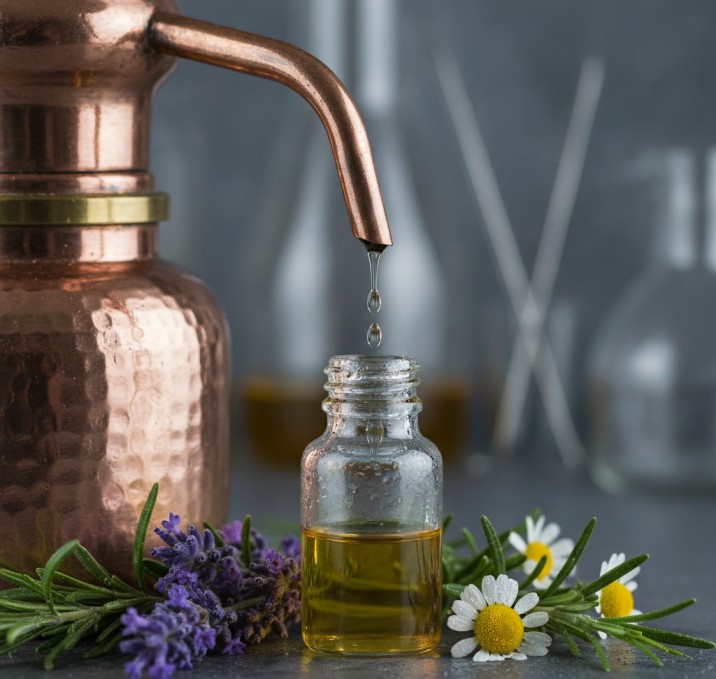
Essential oil portfolios span natural, spice, herbal, absolute, nature-identical, and pharmaceutical-grade variants. Manufacturing approaches differ—steam distillation, cold-pressing, and solvent extraction—so matching method to botanical and end use ensures the right aroma, purity, and compliance profile.
- Natural essential oils: Steam-distilled aromatics (e.g., lavender, eucalyptus). Go-to for diffusers, balms, and serums.
- Spice and herbal oils: High-impact notes (e.g., clove, black pepper, rosemary) favored for warming balms and scalp care.
- Cold-pressed oils: Typically, citrus peels and carrier oils; prized for bright top notes and nutritional lipids.
- Absolute oils: Solvent-extracted for delicate florals (e.g., jasmine, rose) where heat would degrade aroma.
- Nature-identical oils: Consistent profile for cost-stable blends and large-scale fragrance.
- Pharmaceutical-grade: Tight impurity specs and documentation for health-adjacent applications.
AG Organica’s catalog also includes floral waters (hydrosols), fragrances, butters, and aerosols—useful when you want one bill of materials managed by a single partner across skincare, hair care, lip care, baby care, men’s grooming, hygiene, and aromatherapy lines.
Private Label, OEM, and Contract Manufacturing
Turnkey private label and contract manufacturing convert your brief into finished, compliant SKUs. The workflow covers custom formulation, fragrance alignment, safety and stability testing, packaging engineering, and GMP production—so your team focuses on brand, channel, and launch strategy.
- Brief + benchmarks: Target aroma, claims, and region of sale.
- R&D iterations: Lab samples to dial-in feel, spread, and scent.
- Safety & stability: Micro, preservative challenge (where relevant), and compatibility.
- Fragrance development: IFRA category mapping and allergen statements.
- Packaging: Component selection, line trials, and label proofing.
- GMP production: Lot-coded, SOP-driven fills with QC checks.
- Release & logistics: COAs, SDS, carton labels, and export docs.
In our experience, integrated labs remove weeks from back-and-forth sampling. With capacity around 200,000–300,000 units per day and 6000+ SKUs in motion, scaling a hero SKU or seasonal kit becomes an operational routine—not a scramble.

Quality Assurance, Documentation, and Certifications
Trust hinges on documented quality: COAs, GC-MS fingerprints, SDS, IFRA alignment, and GMP-compliant batch records. Layer certifications (ISO 22716, SMETA, Halal, Kosher) and export-ready dossiers so retail, marketplace, and customs checks pass the first time.
- Analytical controls: GC-MS chromatograms, refractive index, specific gravity, optical rotation, and microbial limits with retain samples.
- Regulatory pack: Safety Data Sheets (SDS), Certificates of Analysis (COA), Allergen Declarations, IFRA Category compliance, and labeling proofs.
- GMP signals: ISO 22716-aligned SOPs, calibrated equipment logs, training records, and deviation/CAPA tracking.
- Ethical & access credentials: SMETA social audit, Halal and Kosher certifications, plus regional registrations where applicable.
AG Organica maintains ISO 22716, SMETA, Halal, Kosher, FSSAI, AEO, FDA, AYUSH, and Intertek certifications and exports to 160+ countries—evidence that documentation and process discipline translate into market access.
How To Vet an Essential Oils Manufacturer
Vet manufacturers with a structured scorecard: confirm certifications, inspect labs, sample three lots, and review batch documents. Ask for on-time delivery and defect KPIs. The best partners share data proactively and invite audits, not just plant tours.
-
Practical Scorecard You Can Copy
- Certifications on file: ISO 22716 (GMP), SMETA, Halal, Kosher—verified and current.
- Lab capability: GC-MS access, microbiology suite, fragrance lab; method SOPs documented.
- Sample rigor: Request three non-consecutive lots; check variance in refractive index/specific gravity.
- Packaging compatibility: Two-week line trial; check closure torque, leakage, and label adhesion.
- Documentation: COA, SDS, IFRA/allergen statements matched to SKU and lot.
- Operations: On-time delivery target ≥ 97%; lot rejection rate threshold ≤ 1% with CAPA.
- Transparency: Willingness to share batch records and allow remote/onsite audits.
-
Red Flags to Pause On
- No GC-MS data or “proprietary” refusal to share chromatograms.
- Expired or unverifiable certificates; missing SMETA report.
- Vague answers on packaging compatibility or transport controls.
- Inconsistent lot specs across back-to-back shipments.
Use this scorecard during your supplier qualification. Document findings, assign weights, and keep a running vendor score to guide reorders and line extensions.
-
Tools and Resources for Teams
Equip your team with a shared glossary, a vendor scorecard, and a compliance checklist mapped to your regions of sale. Add a sample approval form and packaging trial log so decisions and learnings are captured once and reused across launches.
- Glossary: GC-MS, COA, SDS, IFRA, RI, SG, CAPA, and accelerated stability conditions.
- Vendor scorecard: Certifications, lab depth, documentation accuracy, delivery performance, and responsiveness.
- Compliance checklist: Label elements, allergen disclosures by market, transport classification, and claims substantiation.
- Packaging trial log: Fill weights, leak checks, torque readings, transit simulation results.
For commerce planning, this overview on selling essential oils online offers channel considerations and merchandising basics. For fragrance development literacy, explore premium perfume ingredients and a niche fragrance guide to align creative briefs with consumer vocabulary.
Case Studies and Real-World Examples
Real programs scale when labs, documentation, and packaging move together. The examples below show how integrated R&D, fragrance development, and GMP execution reduce rework, stabilize specs, and keep retail timelines on track—even during rapid growth.
-
Example : Aromatherapy launch with rapid SKU ramp
- Context: D2C brand needed five diffuser blends and two roll-ons for a nationwide launch.
- Actions: Built fragrance briefs, aligned IFRA categories, ran accelerated stability, and executed line trials on roll-on applicators.
- Outcome: Seven SKUs approved with matching COAs and SDS; packaging passed leak and torque checks; on-time e-commerce go-live.
-
Example : Hair care refresh with spice/herbal notes
- Context: Established FMCG portfolio wanted energizing and clarifying aromas across shampoos and serums.
- Actions: Introduced spice oils (black pepper, clove) and herbal rosemary; tuned dosage to sensory panel feedback.
- Outcome: Consistent aroma acceptance across lots; documented IFRA/allergen statements simplified retailer reviews.
-
Example : Baby care guardrails
- Context: Private-label retailer requested fragrance-light baby lotion and oil with strict documentation.
- Actions: Chose gentle aromatic profiles, ran micro and stability tests, confirmed packaging compatibility on pumps.
- Outcome: Final formulas cleared safety gates; labels and dossiers approved across regions without resubmission.
AG Organica’s infrastructure—2–3 lakh units/day capacity, 6000+ SKUs, and four in-house labs—consistently turns complex briefs into repeatable, global-ready products.
Frequently Asked Questions
These concise answers address the questions buyers ask most when shortlisting an essential oils manufacturer: quality tests, certifications, timelines, and how private label differs from bulk supply. Use them to align internal stakeholders before sampling.
- What lab tests should I insist on before placing a bulk order? Request a COA with GC-MS, refractive index, specific gravity, optical rotation, and microbiology results. For fragranced products, add IFRA category mapping and allergen statements. Keep retain samples for the approved lot and verify documentation matches SKU, region of sale, and batch code.
- How do private label and contract manufacturing differ from bulk oils? Bulk supply delivers verified oils in drums or smaller packs. Private label and contract manufacturing add formulation, testing, packaging engineering, and GMP production to deliver finished SKUs. This model centralizes R&D, documentation, and packaging so you can scale faster with fewer vendors.
- Which certifications help with international retail and marketplace approvals? ISO 22716 (GMP) supports cosmetic manufacturing best practices. SMETA signals ethical sourcing and labor standards. Halal and Kosher expand access for specific consumer groups. Pair these with accurate COAs, SDS, and IFRA alignment to pass documentation checks smoothly.
- What packaging checks reduce leakage and returns? Run compatibility tests with planned components, then execute line trials. Track fill tolerance, closure torque, leak observations, and label adhesion over at least two weeks. Simulate transport conditions to surface failures before full-scale production.
Conclusion and next steps
Choose an essential oils manufacturer with integrated labs, verifiable certifications, and proven volume. Score candidates with a consistent checklist, then pilot two SKUs through full documentation and packaging. Strong partners make quality feel routine and launches feel predictable.
Key takeaways
- Manufacturing success = traceable sourcing + validated labs + GMP packaging.
- Certifications and documentation are your passport to multi-region sales.
- Scorecards and trial runs turn vendor selection into a data-driven process.
- Integrated private label shortens timelines and simplifies scale-ups.
Action steps
- Download or recreate the vendor scorecard and compliance checklist above.
- Shortlist three manufacturers and request three lots per SKU for testing.
- Run a packaging line trial and capture torque, leaks, and fill tolerance.
- Approve one partner for a two-SKU pilot, then expand after stable performance.