
Global Peppermint Oil Market Trends 2026
This market intelligence report is designed to provide B2B buyers, importers, and private label brands with a high-level strategic overview of the peppermint oil landscape. As a primary manufacturer and global exporter, A.G. Organica Pvt Ltd provides these insights to help partners navigate the complexities of sourcing, pricing, and regional demand in 2026.
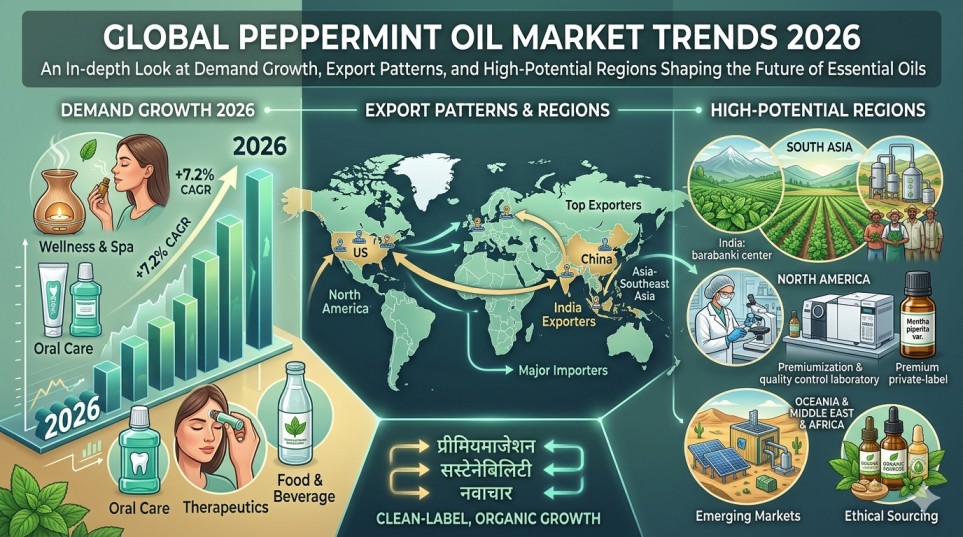
Global Peppermint Oil Market Trends 2026: Demand, Export, and Growth Regions
Global essential oil industry reached a pivotal junction in 2026. Peppermint oil (Mentha × piperita), long a staple in oral care and confectionery, is undergoing a profound transformation. No longer treated as a simple flavoring commodity, it is now a high-value active ingredient driving innovation in the pharmaceutical, clean-label cosmetic, and holistic wellness sectors.
As the world shifts decisively toward plant-based chemistry and traceable supply chains, 2026 marks a turning point where sustainability and pharmaceutical-grade purity have become the primary benchmarks for procurement. For B2B buyers and brands, understanding the interplay between Indian production cycles, American demand, and European regulatory shifts is essential for maintaining a competitive edge.
Global Market Size and Growth Outlook (2026–2033)
The global peppermint oil market in 2026 is characterized by "disciplined expansion." Unlike the volatile spikes seen in emerging niche oils, peppermint oil represents a mature, liquid, and reliable market.
- 2026 Estimated Market Value: ~$217 Million.
- Projected CAGR: 6% – 7% through the forecast period.
- 2033 Market Projection: Exceeding $340 Million+.
Manufacturer’s Intelligence: The Maturity Advantage
The steady CAGR signals that peppermint oil has moved past the "fad" stage of the wellness boom. It is now a core industrial requirement. For bulk purchasers, this stability is an advantage; it allows for long-term contract pricing and predictable inventory cycles, provided you partner with an integrated manufacturer like A.G. Organica that controls the sourcing at the farm level.
>>> Global Essential Oil Market Trends 2025
Core Demand Drivers in 2026
The demand for peppermint oil is being reshaped by four primary industrial pillars:
-
The "Clean Label" Mandate
Across the USA and EU, "synthetic-free" is no longer a luxury—it is a regulatory and consumer expectation. In the food and beverage sector, peppermint oil is the gold standard for natural flavoring, replacing synthetic menthol in premium confectionery and organic beverages.
-
Pharmaceutical & Topical Analgesics
Peppermint oil’s high menthol content makes it indispensable in modern pharma. We are seeing a surge in demand for high-purity oils for:
- Digestive Health: Enteric-coated peppermint capsules for IBS management.
- Pain Management: Topical balms and "migraine sticks" utilizing the oil's natural cooling and vasodilatory properties.
-
The Oral Care Evolution
Oral care remains the highest volume consumer. However, the shift is toward "Functional Oral Care"—toothpaste and mouthwashes that combine peppermint with probiotics or hydroxyapatite, requiring an oil that is consistent in both flavor and antimicrobial potency.
-
Sustainability & Full Traceability
B2B buyers in 2026 are increasingly focused on the "Ethics of the Essence." There is a significant premium placed on oils that can be traced back to the specific distillation batch and farming cluster, ensuring no adulteration and fair labor practices.
Global Export Trends and Trade Flow
The global trade of peppermint oil is a high-stakes logistics operation, with annual exports exceeding $150 Million. The trade flow follows a distinct pattern: Developing Markets Produce → Developed Markets Consume.
Key Export Insights:
- The India-USA Corridor: India remains the world’s leading producer of Mentha arvensis and a significant player in Mentha piperita. Approximately 17% of India’s essential oil exports are directed to the United States, primarily for the oral care and pharma industries.
- Compliance-Led Growth: Export growth is no longer just about volume. It is about certifications. High-growth exporters are those who provide ISO, GMP, and REACH-compliant documentation.
- Quality Consistency: The market is punishing "spot-market" buyers who face rejection at customs due to inconsistent menthofuran or pulegone levels.
>>> Batch Consistency in Bulk Manufacturing
Top Importing and High-Demand Regions
-
North America (~39% Global Market Share)
The USA is the engine of the peppermint market. Demand is driven by a massive pharmaceutical sector and the "Home Wellness" trend. American buyers are currently the most aggressive in securing long-term supply contracts to hedge against climate-related yield fluctuations.
-
Europe (The Sustainability Leader)
European demand, particularly in Germany, France, and the UK, is focused on Clean Beauty. The European Chemicals Agency (ECHA) regulations mean that B2B buyers here require the highest level of documentation and purity, favoring "Therapeutic Grade" oils over standard industrial grades.
-
Asia-Pacific (The Growth Epicenter)
Asia-Pacific is the fastest-growing region. While China and India are major producers, the internal demand in Japan and South Korea for premium personal care products is skyrocketing. The region is expected to lead in peppermint oil consumption growth due to rising disposable incomes and a shift toward Western-style oral care routines.
Pricing Trends and Market Volatility
Peppermint oil exists as a "Semi-Commodity + Premium Hybrid." This means while it follows market indices, the quality premium can cause price variance of up to 40%.
- Price Influencers: Weather patterns in the Indo-Gangetic plains (for Indian Mentha) and the Pacific Northwest (for US Mint) are the primary volatility drivers.
- Price Benchmarks: In times of demand-supply mismatch, prices have historically crossed the ₹1000/kg (approx. $12/kg) mark at the source, significantly impacting the Landed Cost for international buyers.
Strategic Insight: For B2B buyers, "chasing the lowest price" often leads to receiving "folded" or adulterated oils. In 2026, the smart strategy is Price Averaging through a manufacturing partner who can offer stable, year-round pricing based on bulk storage.
>>> How Rare Essential Oils Create Premium Skincare
Supply Chain and Production Trends
-
Supply Chain Regionalization
To avoid global logistics bottlenecks, many brands are moving toward "Regional Hubs." Manufacturers like A.G. Organica now act as these hubs, maintaining ready-to-ship inventory in strategic locations to reduce lead times.
-
Digital Tracking & Blockchain
The 2026 buyer wants to scan a QR code on a drum and see the GC-MS report instantly. Digital transparency is now a mandatory feature of the peppermint oil supply chain.
-
The Oligopoly Challenge
The production of high-quality peppermint oil is concentrated among a few sophisticated manufacturers. This creates a barrier to entry for new brands but offers security for those who have established relationships with tier-1 suppliers.
Application-Wise Demand Breakdown
|
Segment |
Market Role |
2026 Trend |
|
Oral Care |
Volume Leader |
Transition to natural, SLS-free formulations. |
|
Pharmaceuticals |
Value Leader |
High-purity oils for gastrointestinal and topical relief. |
|
Personal Care |
Margin Leader |
"Peppermint Scalp Care" and "Cooling Serums" in luxury beauty. |
|
Food & Beverage |
Steady Staple |
Demand for organic-certified flavoring in craft beverages. |
>>> Who is the largest producer of mint oil in the world?
Strategic Opportunities for B2B Buyers
Where Most Buyers Go Wrong:
- Transactional Sourcing: Treating peppermint oil like a one-off purchase rather than a strategic ingredient.
- Ignoring Compliance: Buying "cheap" oil that fails the stringent pulegone limits required by international safety standards.
- Late Procurement: Waiting for the "dip" in a market that is currently seeing sustained demand growth.
The A.G. Organica Strategic Roadmap:
- Secure Long-Term Partnerships: Shift from "Vendors" to "Partners." A manufacturer-partner ensures that your formulation never changes batch-to-batch.
- Focus on Documentation: Prioritize suppliers who provide comprehensive GC-MS, COA, and MSDS reports with every shipment.
- Private Label Expansion: Use peppermint oil as a "Hero Ingredient" to launch high-margin scalp oils or foot creams under your own brand.
How A.G. Organica Fits into the Global Supply Chain
At A.G. Organica, we understand that our B2B partners aren't just buying oil; they are buying the reliability of their own brand. We bridge the gap between large-scale distillation and boutique brand requirements.
- Bulk Manufacturing: Capable of handling multi-ton requirements with consistent chemical profiles.
- Private Label & OEM: We help brands go from a "Mentha concept" to a retail-ready product in record time.
- Traceability: Every drop of our peppermint oil is backed by rigorous testing and transparent sourcing.
- Export Ready: We are specialists in the documentation required for the USA, EU, and Middle Eastern markets.
>>> Peppermint Oil Benefits: Health, Skincare, Haircare & More
Future Outlook (2026–2033)
The next decade belongs to the "Bio-Active" era. Peppermint oil will move deeper into the cosmeceutical space, with a focus on its ability to act as a penetration enhancer for other active ingredients. While the Asia-Pacific region will dominate production volume, the Premium Markets (North America and Europe) will drive profitability through the demand for organic and therapeutic-grade certifications.
Conclusion:
The peppermint oil market in 2026 is no longer a race to the bottom on price. It is a race to the top on quality, transparency, and strategic partnership. Brands that align themselves with integrated manufacturers will find that peppermint oil is not just a scent or a flavor—it is a foundation for scalable, sustainable growth.
FAQs
- What is the global peppermint oil market size in 2026? The market is estimated at approximately $217 million in 2026, with a steady trajectory toward $340 million by 2033.
- What is driving the demand for peppermint oil? The primary drivers are the "Clean Label" movement in food and cosmetics, the expansion of the pharmaceutical sector using natural menthol, and the rising global popularity of aromatherapy.
- Which countries export the most peppermint oil? India and the United States are the dominant exporters, with India providing significant volume to the global oral care and fragrance industries.
- Which regions have the highest demand? North America holds the largest market share (~39%), followed by Europe. However, the Asia-Pacific region is the fastest-growing market in terms of consumption.
- What industries use peppermint oil the most? Oral care (toothpaste/mouthwash), Pharmaceuticals (pain relief/digestion), Food & Beverage (flavoring), and Personal Care (skincare/haircare).
- Is peppermint oil a growing market? Yes, it is growing at a stable CAGR of 6–7%. This indicates a healthy, mature market with significant opportunities for long-term investment and product development.
Ready to secure your 2026 supply chain? Partner with A.G. Organica for premium, traceable, and export-ready peppermint oil.