
Pharmaceutical Uses of Sweet Almond Oil

The pharmaceutical landscape is currently undergoing a significant shift toward biocompatible, plant-derived excipients. As formulators move away from synthetic mineral oils and petrolatum-based bases, Sweet Almond Oil (Prunus amygdalus dulcis) has emerged as a cornerstone ingredient.
For pharmaceutical companies, contract manufacturers (CMOs), and bulk importers, Sweet Almond Oil is no longer viewed merely as a "natural additive." It is a multi-functional pharmaceutical-grade carrier and excipient capable of enhancing drug delivery, improving patient compliance through better sensory profiles, and ensuring the stability of lipophilic active pharmaceutical ingredients (APIs).
At A.G. Organica Pvt Ltd, we recognize that for bulk buyers, the challenge isn't just finding the oil—it’s finding the right grade that meets stringent pharmacopeia standards while ensuring supply chain scalability. This report serves as a strategic roadmap for the pharmaceutical procurement of Sweet Almond Oil.
What is Sweet Almond Oil?
Sweet Almond Oil is a fixed oil expressed from the seeds of Prunus amygdalus dulcis. In a pharmaceutical context, it is distinguished from its "bitter" counterpart, as it contains no amygdalin, making it safe for both topical and regulated internal applications.
-
Key Functional Properties
- Emollient: Softens and soothes the skin by filling gaps in the lipid barrier.
- Penetration Enhancer: Modifies the stratum corneum to allow deeper API delivery.
- Anti-inflammatory: High phytosterol content helps reduce swelling and irritation.
- Carrier for Actives: Exceptional solubility for lipophilic (fat-soluble) compounds.
-
Chemical Composition & Profile
The pharmaceutical efficacy of the oil is dictated by its fatty acid profile, primarily:
- Oleic Acid (C18:1): 62%–86% (Provides stability and skin permeability).
- Linoleic Acid (C18:2): 20%–30% (Supports barrier repair).
- Tocopherols (Vitamin E): Natural antioxidants that protect the formulation from rancidity.
Why Sweet Almond Oil is Used in Pharmaceuticals
The pharmaceutical industry prioritizes predictability and safety. Sweet Almond Oil excels in these areas due to its high skin compatibility and hypoallergenic nature.
Core Advantages
- Hypoallergenic Profile: Unlike many synthetic bases, refined pharmaceutical-grade almond oil is non-irritating, making it the "Gold Standard" for pediatric and geriatric formulations.
- Stable Fatty Acid Profile: Its high monounsaturated fat content makes it less prone to rapid oxidation compared to polyunsaturated oils like grapeseed or rosehip.
- Enhanced Drug Absorption: It acts as a natural solvent that can carry fat-soluble drugs through the skin’s lipid bilayer more efficiently than water-based systems.
Industry Insight: The value of Sweet Almond Oil in pharma is not just therapeutic; it is mechanical. It improves the delivery efficiency of the API, often allowing for lower concentrations of active ingredients while maintaining efficacy.
Read : Bulk Essential Oil Sourcing for Pharma & Ayurvedic Companies
Pharmaceutical Uses of Sweet Almond Oil
Bulk buyers must categorize their procurement based on the following specific pharmaceutical applications:
-
Topical Formulations (Dermatologicals)
Sweet Almond Oil is used as the primary lipophilic phase in creams, ointments, and lotions. It serves as a superior alternative to liquid paraffin. Because it mimics the skin’s natural sebum, it is used in treatments for eczema, psoriasis, and dermatitis.
-
Advanced Drug Delivery Systems
In the development of Lipid-Based Drug Delivery Systems (LBDDS), Sweet Almond Oil acts as a carrier for lipophilic drugs. It is frequently used in the production of:
- Softgel Capsules: As a solvent for the internal fill.
- Transdermal Patches: To facilitate the steady release of medication.
-
Massage and Therapeutic Medicated Oils
In physiotherapy and pain management, Sweet Almond Oil is the preferred medium for medicated "rub-on" oils. Its "glide" factor is high, and it stays on the skin surface long enough for the therapeutic massage to assist in the absorption of pain-relieving actives like methyl salicylate or herbal extracts.
-
Pediatric and Sensitive Skin Applications
The pharmaceutical baby care market relies heavily on this oil. From cradle cap treatments to diaper rash ointments, its mildness ensures that it does not disrupt the fragile pH balance of infant skin.
-
Ear Drops & Cerumenolytics
Sweet Almond Oil is an official ingredient in several pharmacopeias for ear drops. It safely softens earwax (cerumen) without the irritation often caused by chemical solvents.
Visit : Therapeutic Grade vs Cosmetic Grade Essential Oils
Sweet Almond Oil vs. Other Carrier Oils in Pharma
|
Factor |
Sweet Almond Oil |
Mineral Oil (Paraffin) |
Coconut Oil |
|
Skin Compatibility |
High (Biocompatible) |
Low (Occlusive only) |
Moderate (Comedogenic) |
|
Absorption |
Moderate/Deep |
Minimal |
Moderate |
|
Stability |
Good |
Excellent |
Very High |
|
Regulatory Trust |
High (Pharmacopeia) |
High |
Moderate |
|
Versatility |
High |
Limited to topical |
High (but solidifies) |
Insight: While mineral oils are cheaper, they lack the bio-active properties and penetration-enhancing capabilities of Sweet Almond Oil. For modern pharma, "natural" is a functional requirement, not just a marketing claim.
Selection Criteria for Bulk Buyers
Purchasing for pharmaceutical manufacturing requires a stricter lens than cosmetic sourcing.
-
Grade of Oil
- Refined Pharmaceutical Grade: Necessary for most formulations to ensure the removal of proteins that could trigger nut allergies and to ensure a neutral color and odor.
- Cold-Pressed: Used primarily in therapeutic oils where the preservation of natural vitamins is the priority.
-
Purity & Testing (The "Must-Haves")
A bulk buyer must demand GC/MS (Gas Chromatography-Mass Spectrometry) analysis. This proves the oil hasn't been "cut" with cheaper vegetable oils. Key indicators include the absence of heavy metals, pesticides, and residual solvents.
-
Peroxide Value (PV) & Acid Value (AV)
These are the primary markers of freshness. Pharmaceutical buyers should look for:
- Low Peroxide Value: Indicates the oil has not begun to oxidize.
- Low Acid Value: Indicates the absence of free fatty acids, ensuring stability in emulsions.
Certifications & Compliance Requirements
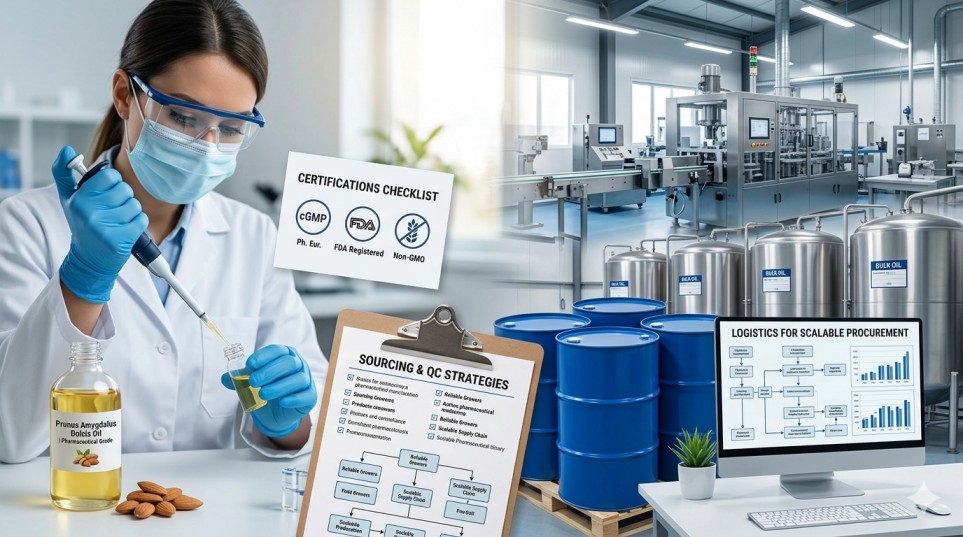
In the B2B pharmaceutical sector, documentation is as important as the product itself.
Must-Have Certifications
- GMP (Good Manufacturing Practices): Ensures the oil is produced in a controlled environment.
- ISO 9001:2015 / 22000: International quality and safety management.
- COA (Certificate of Analysis): A batch-specific document detailing the exact chemical breakdown.
- MSDS (Material Safety Data Sheet): Essential for handling and logistics.
Regulatory Considerations
Bulk buyers must specify which pharmacopeia they are following: USP (United States Pharmacopeia), BP (British Pharmacopeia), or EP (European Pharmacopeia). Each has slightly different testing limits for acidity and sterol composition.
Cost Factors & Pricing Logic (B2B Insight)
Pricing in the bulk almond oil market is volatile and driven by global harvest yields (primarily from California and Spain).
Key Cost Drivers
- Refinement Level: Highly refined pharma-grade oil is more expensive than crude oil due to the multi-step purification process.
- Certification Premium: Oils with verified USP/BP compliance command higher prices because of the rigorous testing involved.
- Extraction Method: Cold-pressing yields less oil than solvent extraction, leading to a higher price per liter.
Challenge the Assumption: The cheapest oil is rarely a "deal." In pharmaceuticals, using a sub-standard oil can lead to batch failures, emulsion separation, or—worse—regulatory recalls. The cost of a recall far outweighs the savings of a low-cost supplier.
Scaling Considerations for Manufacturers
When moving from pilot batches to full-scale production, supply chain stability is paramount.
- Consistency: Can your supplier provide the exact same fatty acid profile six months from now? Seasonal variations can alter the viscosity of the oil, which may affect your machinery settings.
- MOQ Planning: Align your Minimum Order Quantities with your production cycles. At A.G. Organica, we offer flexible scaling to help manufacturers transition from R&D to bulk production.
- Storage: Sweet Almond Oil should be stored in epoxy-coated steel or HDPE drums, nitrogen-flushed to prevent oxidation during transit.
>>> 5 Grades of Essential Oils
Global Market Demand
- North America: Dominates the market for pharmaceutical excipients and specialized drug delivery systems.
- Europe: The strictest regulatory environment; high demand for refined, allergen-free oils.
- Asia (India): Rapidly becoming a global hub for contract pharmaceutical manufacturing, leading to massive bulk imports of high-quality carrier oils.
- Middle East: Expanding local pharma production focusing on dermatologicals.
Why Source from A.G. Organica Pvt Ltd?
As a premier manufacturer and global supplier, A.G. Organica Pvt Ltd understands the technical rigors of pharmaceutical procurement.
- Manufacturing Excellence: Our facility is geared for high-volume production without compromising the delicate chemical integrity of the oil.
- Documentation Support: We provide comprehensive COA, MSDS, and batch traceability that satisfy international regulatory audits.
- Customization: We can offer specific refinement levels tailored to your formulation's viscosity and stability needs.
- Export-Ready: With a robust logistics network, we ensure nitrogen-flushed, secure delivery to pharmaceutical hubs worldwide.
Common Mistakes Bulk Buyers Make
- Ignoring Grade Differences: Using "Cosmetic Grade" for a pharmaceutical application to save costs—leading to stability issues.
- Not Verifying Traceability: Failing to ensure the oil can be traced back to the original harvest.
- Overlooking Oxidation Stability: Buying large quantities without checking the induction period or peroxide values.
- Inconsistent Sourcing: Switching suppliers frequently, which leads to subtle batch variations that can ruin complex emulsions.
Conclusion
Sweet Almond Oil remains a cornerstone of the pharmaceutical industry because it bridges the gap between nature and science. For bulk buyers, the opportunity lies in its versatility—from ear drops to advanced transdermal drug delivery. However, the path to a successful product launch is paved with strict adherence to quality standards and transparent sourcing.
By prioritizing pharmaceutical-grade refinement and robust documentation, manufacturers can ensure that Sweet Almond Oil does more than just "fill" a formula—it enhances it.
FAQs
- What are the pharmaceutical uses of Sweet Almond Oil? Sweet Almond Oil is used as a carrier for lipophilic drugs, an emollient in dermatological creams, a solvent in softgel capsules, a cerumenolytic in ear drops, and a base for medicated massage oils.
- Is Sweet Almond Oil safe for pharmaceutical formulations? Yes, especially when refined to pharmaceutical standards. Refined almond oil removes potential allergens (proteins) and impurities, making it hypoallergenic and safe for sensitive skin and pediatric use.
- What grade of Sweet Almond Oil is used in pharma? Pharmaceutical manufacturers typically require Refined Sweet Almond Oil that complies with USP, BP, or EP standards. This ensures neutral odor, color, and high oxidative stability.
- How do bulk buyers ensure quality when sourcing? Buyers should demand batch-specific Certificates of Analysis (COA), GC/MS reports to verify fatty acid composition, and proof of GMP-compliant manufacturing.
- What certifications are required for pharmaceutical oils? Key certifications include GMP (Good Manufacturing Practices), ISO 9001/22000, and compliance with pharmacopeia monographs (USP/BP/EP). MSDS and COA are mandatory for all batches.
- How does Sweet Almond Oil help in drug delivery? It acts as a penetration enhancer, temporarily altering the skin barrier to allow active ingredients to pass through more easily. Its high solubility also makes it an ideal vehicle for fat-soluble vitamins and drugs.