
Buy Essential Oils for Soap Making

Buying essential oils for soap making can feel overwhelming. You look online and see hundreds of websites. One shop sells Lavender for $10, while another sells it for $50. Some claim to be "therapeutic grade," while others say they are for "external use only."
It is hard to know who to trust. If you choose the wrong oil, you could ruin a whole batch of soap or, worse, create a product that irritates the skin.
This guide will help you cut through the confusion. You will learn how to spot quality, what to avoid, and where professionals get their supplies.
Why Essential Oil Quality Matters in Soap Making
When you make soap, you aren't just mixing scents. You are working with a chemical process. The quality of your oil affects the final result in several ways:
- Scent Retention: Cheap or diluted oils often disappear during the curing process. A high-quality oil stays strong even after the soap sits for weeks.
- Skin Safety: Pure essential oils are predictable. Synthetic fillers or "faked" oils can cause rashes or allergic reactions.
- Batch Consistency: If you sell your soap, customers expect the same scent every time. Reliable suppliers provide consistent batches.
- Heat Stability: Soap making involves heat. Pure oils handle this better than low-quality versions that might "flash off" or change smell.
Common Places People Buy Essential Oils
Most makers start by buying from the easiest sources. Here is what you should know about them:
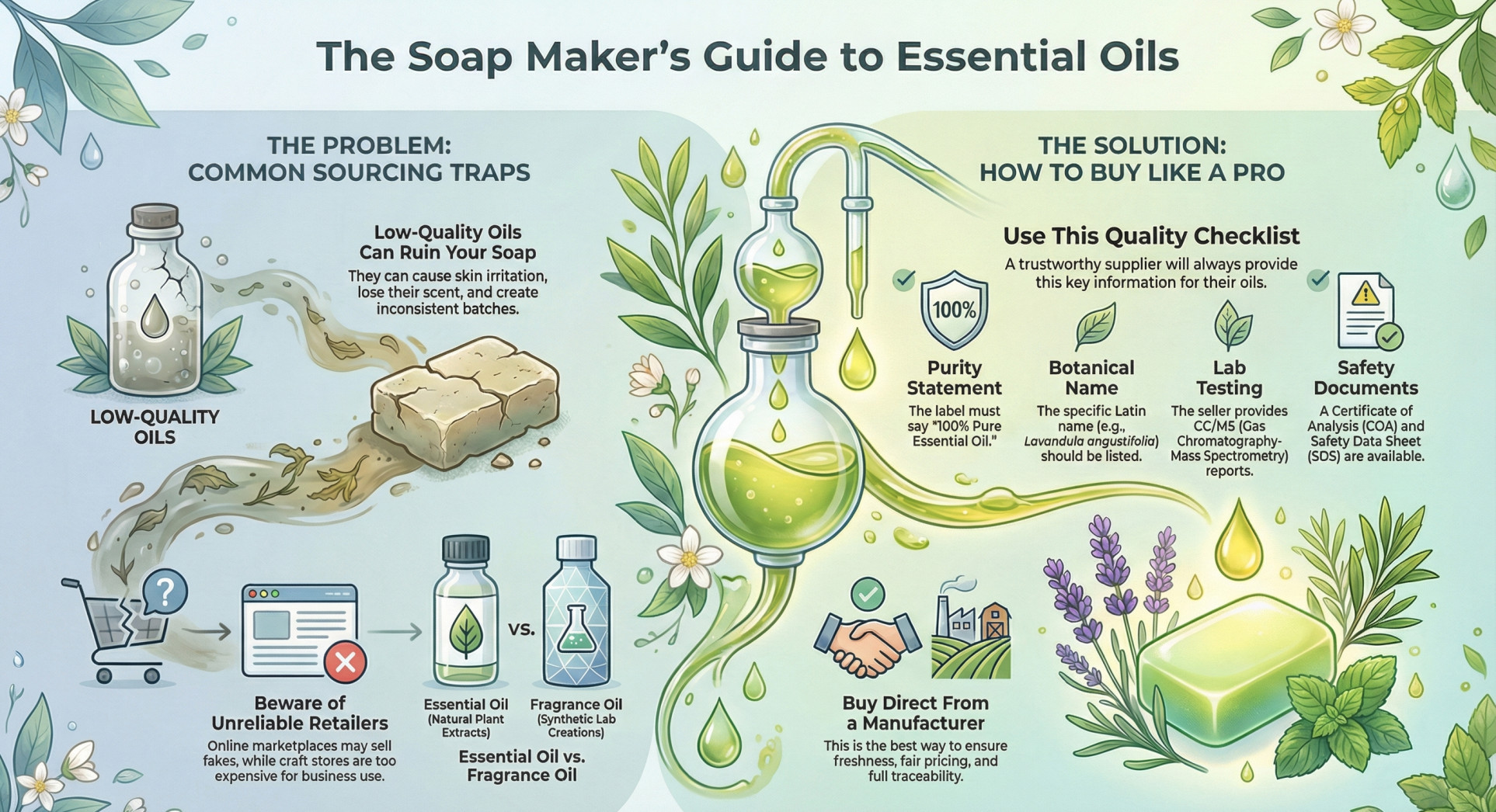
- Online Marketplaces - Sites like Amazon or eBay are convenient. However, they are full of resellers. It is hard to verify if the oil inside the bottle matches the label. Many "cheap" oils on these sites are actually synthetic fragrances mixed with a little bit of real oil.
- Local Craft Shops - These are great for a last-minute hobby project. But for a business, they are expensive. The bottles are small, and you rarely get access to safety documents or batch reports.
- Importers and Resellers - Many companies buy oil from overseas and put their own label on it. While many are honest, they are still middlemen. This adds to the cost. They also may not have direct control over how the oil was distilled or stored.
What to Look for When Buying Essential Oils for Soap
To find a safe and reliable oil, use this checklist before you hit "buy":
- Purity: The label should say "100% Pure Essential Oil." Avoid "Perfume Oil" or "Nature Identical Oil."
- Botanical Name: Look for the Latin name. For example, Lavender should also say Lavandula angustifolia. This proves the seller knows exactly what plant they used.
- Country of Origin: A good supplier tells you where the plant was grown.
- Extraction Method: It should state if the oil was steam distilled or cold-pressed.
- Batch Testing: Ask if they have GC/MS (Gas Chromatography-Mass Spectrometry) reports. This report shows the exact makeup of the oil.
- Safety Documentation: Professionals look for a COA (Certificate of Analysis) and an SDS (Safety Data Sheet).
Why Buying Directly From a Manufacturer Matters
Buying from the people who actually make the oil is a different experience. When you work with a manufacturer like AG Organica, you skip the middlemen.
Manufacturers have direct control over the sourcing of plants and the distillation process. This leads to fresher batches. Because they produce in large volumes, the pricing is usually much more stable for a growing business. You also get full traceability, meaning you know exactly where your oil started and how it was handled.
Where to Buy Essential Oils for Soap Making
If you are moving beyond a hobby and want professional results, you should look for a dedicated manufacturer and exporter.
AG Organica is a leading name in this space. They supply essential oils to soap makers and cosmetic brands worldwide. Their focus is on purity and rigorous testing. Whether you are making small batches at home or planning a private label soap line, they provide the documentation and consistency that professionals need.
Best Essential Oils for Soap Making
Not every oil behaves the same way in soap. Here are some of the most popular choices:
- Lavender: The most popular choice. It holds its scent well and is very kind to the skin.
- Lemongrass: A very strong, "punchy" scent. It is affordable and stays vibrant in cold-process soap.
- Tea Tree: Great for "cleansing" soaps. It has a medicinal scent that many people love for hand soaps.
- Peppermint: Provides a cooling sensation. It is very strong, so a little goes a long way.
- Eucalyptus: Offers a fresh, spa-like aroma. It pairs well with Mint or Lemon.
- Orange: A bright, happy scent. Note that citrus oils can sometimes fade faster, so they are often mixed with "fixatives" like Litsea Cubeba.
How to Buy Essential Oils in Bulk for a Soap Business
When your hobby turns into a business, buying 30ml bottles is no longer practical. Here is how to handle bulk buying:
- Understand MOQ: Manufacturers usually have a Minimum Order Quantity. This might be 1kg or 5kg.
- Check Packaging: Bulk oils should come in airtight, UV-protected containers (like aluminum or dark high-grade plastic) to prevent oxidation.
- Storage: Keep your oils in a cool, dark place. This preserves the scent and the skin-safe properties.
- Ask for Documents: When buying bulk, always ask for the COA for that specific batch.
Mistakes Soap Makers Make When Buying Oils
- Choosing Price Over Purity: If the price seems too good to be true (like $5 for Sandalwood), it is likely synthetic or diluted.
- Ignoring Test Reports: If a supplier cannot show you a lab report, they might not know what is in their own product.
- Buying Fragrance Oils by Mistake: Fragrance oils are synthetic. They are fine for scent, but they are not "essential oils" and do not have the same natural benefits.
- Not Checking the Supplier's Background: Always look for a supplier who specializes in oils, not just general craft supplies.
Frequently Asked Questions
- Can essential oils be used directly in soap? Yes, essential oils are the standard way to naturally scent soap. However, they must be diluted into the soap oils according to safe usage rates.
- Are fragrance oils the same as essential oils? No. Essential oils come from plants. Fragrance oils are made in a lab. While fragrance oils can smell nice, they do not offer the natural properties of plant extracts.
- How much essential oil is needed for soap? Typically, soap makers use about 3% of the total oil weight for scenting. This can vary depending on the strength of the specific oil.
- Can beginners buy in bulk? Yes. If you know you will use a lot of a specific oil, like Lavender, buying in bulk saves money and ensures your batches always smell the same.
Conclusion
Choosing the right essential oil is the difference between an okay soap and a great one. By focusing on purity and asking for the right paperwork, you protect your customers and your reputation.
For those looking for a reliable partner, AG Organica offers the quality and transparency needed for both small-scale and commercial soap making.