
Top High-Margin Carrier Oils for Private Label Brands
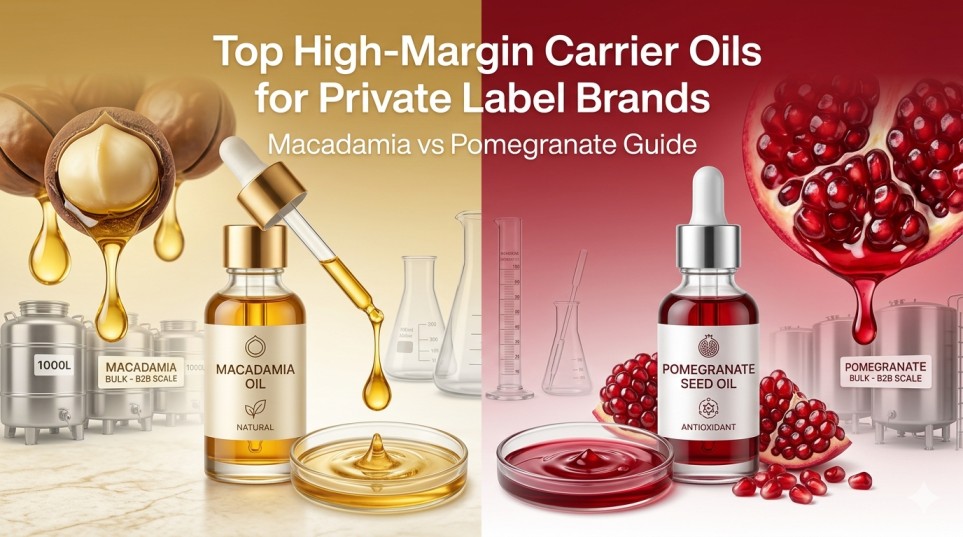
Why Macadamia & Pomegranate Lead the Market
Published by AG Organica | Bulk Oil Supplier & Private Label Cosmetic Manufacturing Partner
Executive Summary
The global carrier oil market is undergoing a significant structural shift. Brands that built their product lines on commodity oils — sweet almond, coconut, mineral — are facing thinning margins, rising competition, and increasing pressure from consumers demanding more functional, transparent ingredients.
Two oils are leading the next generation of high-margin formulations: macadamia nut oil and pomegranate seed oil. Both have emerged as clear leaders in the premium botanical segment — not because of trend alone, but because of measurable commercial advantages that compound across the supply chain.
|
40–60% Price Premium Over Commodity Oils vs. almond and coconut oil |
|
$39M+ Pomegranate Market (2034) CAGR ~5%, cosmetics-driven |
|
~65% Macadamia Cosmetic Demand of total macadamia oil demand |
For private label brands, these oils are not just ingredients. They are margin multipliers and brand positioning tools. Used correctly, they allow brands to move up the value chain — commanding higher retail prices, building stronger consumer loyalty, and generating better per-unit economics than any commodity oil can deliver.
This report covers the market evidence, profit mechanics, sourcing considerations, and strategic frameworks behind both oils — giving B2B buyers, formulators, and private label brands the data needed to make high-confidence sourcing decisions.
Market Landscape: The Shift Toward High-Value Oils
The consumer skincare market has moved on. What worked in 2015 — a simple almond oil serum, a coconut-based hair mask — no longer commands the same shelf space, search ranking, or brand loyalty. Consumers are more ingredient-literate than they have ever been. They read labels. They research actives. They ask why.
This shift is not a short-term trend. It is a structural realignment driven by three converging forces.
- Over 41% of consumers now actively prefer natural oils in their skincare routine
- Premium botanical oils are replacing synthetic actives across mid-market and luxury formulations
- Anti-aging demand, the clean-label movement, and functional skincare (omega-rich, antioxidant-based) are all accelerating simultaneously
What Makes a Carrier Oil 'High-Margin'?
Not all natural oils are equal in commercial terms. Five factors separate a high-margin carrier oil from a commodity ingredient.
|
Factor |
Effect on Margin |
Macadamia |
Pomegranate |
|
Scarcity / Limited Supply |
Drives sustained price premium |
Moderate (7–10yr tree maturity) |
High (low yield, seasonal) |
|
Functional Benefits |
Enables premium claim-based branding |
Strong (palmitoleic acid) |
Very strong (punicic acid, antioxidants) |
|
Origin & Extraction Story |
Increases perceived value |
Strong (Australian provenance) |
Very strong (Moroccan/Middle Eastern origin) |
|
Low Commoditization |
Supports higher pricing power |
Moderate (growing, not saturated) |
High (niche, specialist ingredient) |
|
Multi-Industry Demand |
Stabilizes margins across market cycles |
High (food, cosmetics, pharma) |
Moderate (cosmetics, wellness-led) |
|
Macadamia and pomegranate seed oils outperform on all five criteria. This is not a coincidence — it is the result of underlying supply economics, consumer preference data, and formulation science all pointing in the same direction. |
Macadamia Oil: The Luxury Base Oil
Macadamia nut oil has quietly become one of the most commercially reliable premium carrier oils on the market. It does not have the viral marketing history of argan oil. It does not carry the cultural mythology of rose hip. What it has is consistent performance across formulation, supply chain, and margin — which is ultimately what brand-builders need.
Market Position
- Cosmetics account for approximately 65% of total global macadamia oil demand
- Widely adopted in luxury skincare, prestige haircare, and professional salon formulations
- Growing usage in nutraceuticals and premium food — a multi-industry demand base that stabilizes pricing
Why Macadamia Oil Delivers High Margins
-
Skin Compatibility That Is Hard to Match
Macadamia oil is exceptionally rich in palmitoleic acid — an omega-7 fatty acid that occurs naturally in human sebum and declines measurably as skin ages. This biological alignment is not just a marketing claim. It translates to real formulation advantages: faster absorption, lower occlusion, and better skin compatibility across most skin types. For brands making clinical or results-based claims, these properties provide substantive backing.
-
The Price Premium Advantage
Products formulated with macadamia oil as a hero ingredient consistently generate 25 to 30% higher retail margins compared to equivalent products built around commodity oils. This premium is driven partly by ingredient recognition, partly by demonstrated efficacy, and partly by the perceived sophistication of the oil in consumer education materials.
-
Supply Constraint as Pricing Power
Macadamia trees take between 7 and 10 years to reach commercial bearing. This long lead time acts as a natural brake on oversupply — which is exactly why macadamia oil has maintained more stable pricing than most carrier oils over the past decade. When demand increases faster than new orchards can produce, prices hold. Brands that secure consistent bulk supply relationships benefit disproportionately.
-
Multi-Industry Demand:
Unlike oils that serve only the cosmetics sector, macadamia oil commands significant demand across premium food products and nutraceuticals. This cross-industry demand floor prevents the price compression that affects single-use cosmetic oils and makes macadamia one of the more commercially resilient base oils to build a product line around.
|
Strategic Insight: Macadamia oil works best as a luxury base — not a hero ingredient. Position it as the 'premium delivery vehicle' for your actives. In facial oils, anti-aging creams, and hair serums, macadamia enables 'accessible luxury' pricing — above mass market, below ultra-premium. |
Pomegranate Seed Oil: The High-Value Active Oil
If macadamia oil is the scalable luxury base, pomegranate seed oil is its high-value counterpart — a functional active that commands ultra-premium pricing, carries exceptional clinical credibility, and operates in a category where competition remains genuinely low. For private label brands that understand how to use it, pomegranate seed oil is one of the most powerful margin tools available in the botanical oil market.
Market Size and Growth
|
~$39M Projected market value by 2034 |
~5% Compound annual growth rate (CAGR) |
~63% Of demand from cosmetics sector |
Why Pomegranate Seed Oil Commands High Margins
-
Active Ingredient Positioning — Not Just a Carrier
Most carrier oils are positioned as delivery vehicles. Pomegranate seed oil is positioned as an active ingredient in its own right. Its exceptional concentration of punicic acid — a rare conjugated linolenic acid (omega-5) not found in significant quantities in any other plant oil — gives it genuine biological activity: anti-inflammatory, pro-regenerative, and strongly antioxidant. This is not marketing language. It is measurable chemistry that supports clinical claim development.
-
Premium and Organic Revenue Concentration
Organic variants of pomegranate seed oil contribute approximately 60% of category revenue — significantly higher than most carrier oils. This organic concentration means the customer base that drives market growth is already willing to pay premium prices. For brands entering this space, that is an exceptionally favorable demand structure.
-
Anti-Aging Narrative Strength
The anti-aging segment accounts for approximately 36% of pomegranate seed oil demand in cosmetics. This is not a coincidence. The combination of punicic acid, ellagic acid, and phytoestrogen compounds in pomegranate seed oil maps directly onto the most commercially powerful claims in modern skincare: cellular regeneration, collagen support, oxidative protection, and skin elasticity. Brands that build around pomegranate seed oil in the anti-aging segment are entering one of the highest-growth, highest-spend categories in the global beauty market.
Key Limitation — and Why It Is Actually an Advantage
Pomegranate seed oil has a low extraction yield and relies on seasonal raw material supply. This is frequently cited as a drawback. It is more accurately understood as a structural price floor. Low yield means high cost. High cost means high retail prices are necessary. High retail prices mean premium positioning is not optional — it is required. Brands that enter this category cannot compete on price even if they wanted to. The market forces them into premium territory, which is exactly where margins live.
|
Strategic Insight: Position pomegranate seed oil as a hero ingredient — the reason someone buys your product. It should be front and center on your label, your marketing, and your clinical claims. Brands that bury it in a long ingredient list leave significant margin on the table. |
Comparative Analysis: Why These Two Oils Lead
The case for macadamia and pomegranate seed oil is strongest when they are understood together — not as competitors, but as complementary instruments in a high-margin formulation strategy.
|
Criteria |
Macadamia Nut Oil |
Pomegranate Seed Oil |
|
Role in Formulation |
Base oil — delivery and texture |
Active ingredient — efficacy and claims |
|
Margin Potential |
High (25–30% premium vs. commodity) |
Very High (ultra-premium pricing tier) |
|
Pricing Stability |
Strong — supply constrained by maturation cycle |
Strong — limited yield supports price floor |
|
Cosmetic Demand Share |
~65% of total oil demand |
~45–63% in personal care applications |
|
Key Functional Benefit |
Skin compatibility, fast absorption, anti-aging |
Cellular regeneration, antioxidant, anti-aging |
|
Brand Positioning |
Accessible luxury carrier |
Functional super-ingredient |
|
Competition Level |
Moderate — recognized but not saturated |
Low — genuinely niche, specialist positioning |
|
Organic Demand |
Growing — multi-origin certified supply available |
Very High — ~60% of revenue from organic variants |
|
Best Formulation Context |
Facial oils, serums, hair treatments, body oils |
Serums, night oils, regenerative treatments, eye care |
|
Supply Risk |
Low-moderate — multi-origin global cultivation |
Moderate — seasonal, geographically concentrated |
|
Reading the table: Macadamia = scalable premium base. Pomegranate = high-margin differentiation layer. Together, they create formulations that are both commercially resilient and premium-positioned — a rare combination in the carrier oil market. |
Profit Strategy for Private Label Brands
Understanding the commercial case for each oil individually is useful. Understanding how to use them together is where real brand strategy begins.
The High-Margin Formulation Architecture
|
|
BASE LAYER Macadamia Nut Oil Cost-efficient luxury carrier Scalable · High margins · Skin-compatible |
|
ACTIVE LAYER Pomegranate Seed Oil Ultra-premium differentiation booster Niche · High-ticket · Anti-aging story |
|
This two-layer architecture delivers three commercial outcomes simultaneously. It gives you premium pricing justification — because both ingredients carry real consumer recognition and clinical credibility. It gives you a strong ingredient story — because each oil has a distinct provenance, mechanism, and benefit. And it gives you better perceived efficacy — because the formulation is genuinely more functional than anything built on a single commodity base.
Best-Selling Product Opportunities
These five product types represent the highest commercial potential for private label brands entering or scaling in the premium botanical oil segment.
|
Product Type |
Primary Oil |
Active Oil |
Target Price Point |
Key Claim |
|
Anti-Aging Facial Oil |
Macadamia (base) |
Pomegranate (5–10%) |
$38 – $75 |
Regenerative, antioxidant-rich |
|
Brightening Serum |
Macadamia (base) |
Pomegranate (8–15%) |
$42 – $85 |
Radiance, even skin tone |
|
Luxury Hair Treatment Oil |
Macadamia (primary) |
Pomegranate (optional) |
$28 – $55 |
Strength, shine, anti-breakage |
|
Night Repair Oil |
Macadamia (base) |
Pomegranate (10–20%) |
$45 – $90 |
Overnight regeneration |
|
Scar / Regenerative Oil |
Macadamia (base) |
Pomegranate (15–25%) |
$35 – $70 |
Healing, skin renewal |
Pricing and Margin Insights
The relationship between raw material cost and final margin is frequently misunderstood in private label cosmetics. Many brands assume that lower raw material cost automatically produces higher profit. The data shows the opposite — premium ingredient cost drives premium retail positioning, which produces substantially better margin outcomes at scale.
|
Oil Type |
Bulk Cost Trend |
Retail Positioning |
Typical Retail Price (30ml) |
Gross Margin Potential |
|
Commodity Oils (Almond, Coconut) |
Low — falling with oversupply |
Mass market |
$6 – $14 |
25 – 40% |
|
Macadamia Nut Oil |
Medium-high — stable, supply-constrained |
Premium / mass-premium |
$22 – $45 |
55 – 72% |
|
Pomegranate Seed Oil |
High — low yield, seasonal |
Ultra-premium |
$45 – $90+ |
65 – 80% |
|
Macadamia + Pomegranate Blend |
Medium-high — blend manages cost |
Luxury premium |
$40 – $85 |
60 – 78% |
|
Key Reality: Higher raw material cost does not mean lower profit. It means higher minimum viable pricing — which, when supported by strong branding and formulation quality, consistently delivers better margins than low-cost alternatives competing on price. |
Market Trends Supporting Growth
The commercial case for macadamia and pomegranate seed oil is reinforced by four macro trends that are structural — not cyclical. These are not temporary demand spikes driven by social media virality. They are demand shifts with multi-year periods.
|
Trend |
Market Evidence |
Impact on These Oils |
|
Clean Beauty Movement |
Demand for cold-pressed, organic, non-toxic oils rising sharply across all price segments |
Direct benefit — both oils are cold-pressed, plant-derived, and organic-certifiable |
|
Anti-Aging Boom |
Anti-aging skincare is the single largest segment in premium beauty globally |
Pomegranate's punicic acid and macadamia's palmitoleic acid are both validated anti-aging actives |
|
Ingredient Transparency |
44% of brands now actively highlight clean-label and traceable sourcing |
Both oils have strong origin stories and supply chain traceability advantages |
|
Premiumization of Skincare |
Consumers are trading up — willing to pay significantly more for proven naturals |
Creates ideal conditions for both oils in mid-premium and luxury segments |
|
Functional Skincare Growth |
Efficacy claims backed by ingredient science are outperforming texture-only products |
Both oils carry genuine biological activity that supports clinical and functional claims |
|
Men's Grooming Expansion |
Male skincare spend growing at above-category rates, particularly in the premium segment |
Macadamia's lightweight absorption is ideal for male-targeted facial and grooming products |
Competitive Advantage for B2B Manufacturers: AG Organica
For B2B manufacturers, distributors, and private label brands, the strategic shift toward high-value botanical oils creates tangible commercial advantages — but only when backed by a supply partner with the infrastructure to deliver consistency, documentation, and scale.
AG Organica supplies both macadamia nut oil and pomegranate seed oil to cosmetic manufacturers, private label brands, and distributors across 40+ countries. GMP-certified. Full documentation. Export-ready.
Commercial Advantages We Enable
|
Differentiation from Commodity Competition • Move product lines away from saturated ingredients • Build brand positioning around functional premium actives • Access oils with genuine niche and specialist credibility • Develop unique formulations with traceable, certified ingredients |
|
Higher Deal Value and Export Potential • Premium oils increase average order value (AOV) by 2–4x • Strong demand in USA, EU, Japan, and GCC markets • Private label upsell to organic, cold-pressed, and therapeutic-grade • Export documentation, COA, and stability data provided |
What AG Organica Supplies
|
Product / Service |
Details |
MOQ |
|
Bulk Macadamia Nut Oil |
Cold-pressed, cosmetic grade, multi-origin (Australia, South Africa, Kenya) |
From 25 kg |
|
Bulk Pomegranate Seed Oil |
Cold-pressed, cosmetic grade, organic certified available |
From 10 kg |
|
Custom Botanical Blends |
Macadamia + pomegranate and other formulations to specification |
From 50 kg |
|
Private Label Facial Oils |
Branded, packaged, full documentation, export-ready |
From 500 units |
|
Private Label Serums |
Custom or ready formulation with complete packaging support |
From 500 units |
|
White Label Cosmetics |
Fast-track branded products for rapid market entry |
From 250 units |
|
Related Guides: [Macadamia Oil Benefits Guide] | [Argan Oil Supplier Guide] | [Private Label Cosmetic Manufacturing] |
Conclusion
|
Macadamia = Margin Foundation. Pomegranate = Premium Multiplier. |
Macadamia and pomegranate seed oils are not trending ingredients. They represent a structural shift in how the carrier oil market values performance, scarcity, and consumer storytelling.
Macadamia oil anchors profitability through scalability and luxury appeal. It gives brands a cost-efficient, skin-compatible base that supports premium pricing without requiring premium-level raw material spend across the entire formula. Pomegranate seed oil drives premium positioning and differentiation. Used as a hero ingredient with genuine clinical backing, it justifies retail prices that commodity oil formulations cannot approach.
Together, they create a formulation architecture that outperforms on every commercial metric that matters to private label brands: gross margin, brand positioning, ingredient storytelling, and customer retention.
Brands that understand this layering strategy will outperform competitors still building product lines around oils that were the industry standard a decade ago. The window to build premium botanical brands with strong margin economics is open. But it will not stay open indefinitely as more brands make the same shift.
Ready to Source Macadamia or Pomegranate Seed Oil?
Contact AG Organica for certified bulk supply, sample requests, and private label manufacturing quotes.