
Global Neroli Oil Market Trends 2026
Global Neroli Oil Market Trends 2026
—What Buyers & Manufacturers Must Know
Published by AG Organica | Bulk Oil Supplier & Private Label Cosmetic Manufacturing Partner | 2026
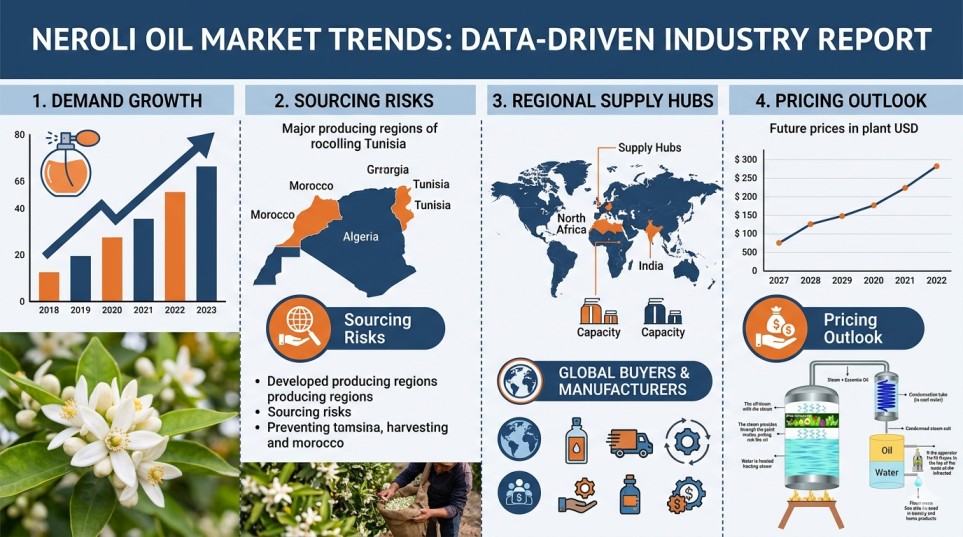
Global Neroli Oil Market Trends 2026: What Buyers & Manufacturers Must Know
The global Neroli oil market is projected to reach approximately $945 million by 2034, growing from a 2026 valuation of $699 million. While these figures suggest a robust upward trajectory, they mask a deeper, more complex reality for procurement officers and brand owners: Supply fragility is the real story of 2026.
As luxury skincare and "clean-label" fragrances continue to dominate consumer preferences, Neroli—the essential oil distilled from the blossoms of the bitter orange tree (Citrus aurantium)—has transitioned from a niche aromatic to a strategic botanical asset. For global manufacturers like AG Organica, the challenge is no longer just sourcing; it is managing a supply chain that is increasingly sensitive to climate volatility and labor shifts.
Outline: Table of Contents
- Market Overview & Growth Outlook (2026–2030)
- Primary Demand Drivers: Beyond the Scent
- The Supply Bottleneck: Yield vs. Demand Mismatch
- Regional Sourcing Hubs: A GEO-Intelligence Map
- Price Volatility & The USD 180,000/Ton Reality
- Procurement Strategies for High-Margin Brands
- Future Outlook: Predictive Trends for 2030
- Why AG Organica is Your Strategic Sourcing Partner
- Frequently Asked Questions (FAQ)
Market Overview & Growth Outlook (2026–2030)
According to recent industry data (Intel Market Research, 2026), the global Neroli oil market is exhibiting a Compound Annual Growth Rate (CAGR) of 5.3%. By the end of 2026, the market is expected to sit comfortably at $699 million, with a clear path toward the billion-dollar mark by the early 2030s.
Key Market Insights
- Current Valuation: ~$699M (2026 Forecast).
- Projected Valuation: ~$945M by 2034.
- Average Wholesale Price: ~$180,233 per metric ton for high-purity variants.
- Volume Metrics: Global sales reached approximately 4,034 tons in 2025.
Is the Neroli Oil market growing?
Answer: Yes. The market is witnessing steady growth driven by the "clean beauty" movement, a resurgence in luxury perfumery, and the expansion of the aromatherapy sector in the Asia-Pacific region.
Demand Drivers Reshaping the Neroli Oil Market
Demand is no longer a monolith. It is being pulled by three distinct industry engines, each with specific quality requirements.
- The Clean Beauty & "Skin-Intellectual" Movement: Today’s consumers are "skin-intellectuals." They look past the marketing fluff to the INCI list. Neroli’s natural antimicrobial and antioxidant properties make it a darling of the clean beauty sector. Brands are moving away from synthetic "Orange Blossom" fragrances toward the authentic, bioactive Neroli oil to support claims of "skin regeneration" and "barrier repair."
- The Aromatherapy & Wellness Boom: Post-2024 wellness trends have prioritized stress-relief and anxiolytic (anti-anxiety) products. Industry reports indicate that over 60% of wellness centers and luxury spas now incorporate Neroli into their signature treatments. Clinical research validating Neroli's effect on the nervous system has further opened doors in the pharmaceutical and nutraceutical sectors, which are growing at an estimated 9.2% CAGR.
- Luxury Fragrance Expansion: While mass-market perfumes use synthetic nerol or geraniol, Prestige and Niche perfumery rely on the "green-floral" complexity of authentic steam-distilled Neroli. As the middle class expands in India and China, the demand for "Niche" fragrances that utilize high-cost naturals has spiked by 12% annually.
Supply Constraints – The Real Bottleneck
The central paradox of the Neroli market is that while demand is scalable, the source is not.
The Yield Crisis
Neroli is arguably one of the most labor-intensive oils in the world. The extraction yield is incredibly low—ranging from 0.05% to 0.15%.
- Fact: It takes roughly 1,000 kilograms (1 ton) of hand-picked blossoms to produce just 1 kilogram of pure Neroli oil.
Climate Sensitivity & Labor Dependency
- Harvest Window: The blossoms must be hand-picked in a narrow window (late April to early May).
- Weather Volatility: A single unseasonal frost or heatwave in Tunisia or Morocco can wipe out 30% of the global annual supply.
- Manual Labor: Unlike lavender, which can be mechanically harvested, the delicate bitter orange blossoms require human hands. As labor costs rise in traditional North African hubs, the cost of production rises proportionally.
"Growth exists, but supply fragility is the real story. Buyers who treat Neroli like a scalable commodity are in for a shock by 2027." — Industry Analyst Quote
Regional Sourcing Hubs: A GEO-Intelligence Map
Success in the 2026 market depends on knowing where your oil comes from. Geographical origin dictates the chemical profile (Linalool vs. Limonene ratios).
|
Region |
Market Role |
Key Strength |
|
Tunisia |
Global Leader |
High-volume production, established distillation heritage. |
|
Morocco |
Premium Supplier |
Renowned for organic-certified, high-purity oils. |
|
Egypt |
Growth Hub |
Competitive pricing and expanding infrastructure. |
|
France (Grasse) |
Processing Epicenter |
The global hub for high-end fragrance formulation using imported raw oils. |
|
India (UP/Delhi) |
Emerging OEM Power |
Fast-growing hub for custom formulations and bulk B2B export. |
Strategic Insight: Tunisia and Morocco currently account for over 40% of the global supply. However, climate shifts are pushing manufacturers like AG Organica to diversify sourcing toward reliable, multi-origin networks.
Price Volatility & Market Reality
For B2B buyers, the "standard" price is a moving target. In 2025/2026, wholesale prices for therapeutic-grade Neroli have stabilized between $8,000 and $15,000 per kilogram, depending on certification and origin.
Price Drivers in 2026:
- Adulteration Risks: Because of the high price, the market is flooded with "Neroli blends" (often diluted with petitgrain or synthetics). Pure, batch-tested oil commands a 30-40% premium.
- Certification Costs: Organic and IFRA-compliant certifications now add an estimated $30-$40 per kg to production costs (Technavio, 2026).
- Inventory Hoarding: Larger fragrance houses are increasingly locking up 24-month supplies, leaving smaller D2C brands to compete for the remaining "spot market" volume.
Procurement Strategy for Buyers: 4 Pillars of Success
In a supply-constrained market, procurement is no longer a transaction—it is risk management.
- Move Beyond "Spot" Buying: Don't wait for a product launch to find your oil. High-margin brands are now entering long-term contracts (12-24 months) to lock in pricing and guarantee allocation before the spring harvest begins.
- Prioritize Traceability (E-E-A-T): Google’s E-E-A-T (Experience, Expertise, Authoritativeness, and Trustworthiness) standards aren't just for content; they are for supply chains. Buyers must demand Gas Chromatography-Mass Spectrometry (GC-MS) reports for every batch to ensure the Linalool-Linalyl acetate balance is authentic.
- The "Blended" Strategic Alternative: For brands targeting mid-market tiers, consider a Neroli-Petitgrain hybrid. Since Petitgrain comes from the leaves of the same tree, the olfactory profile is complementary, but the cost is significantly lower.
- Partner with Integrated Manufacturers: Working with a partner like AG Organica—who handles both the raw oil sourcing and the final formulation—reduces the "middleman markup" and ensures that the oil used in your samples is the exact same oil used in your 10,000-unit production run.
Future Outlook: Predictive Trends for 2030
What will the market look like in five years?
- The Rise of Bio-Based Extraction: Supercritical CO2 extraction will become more common, offering a "greener" profile that appeals to Gen Alpha consumers.
- India as a Global OEM Hub: With advanced labs and massive production capacity (2-3 lakh units/day at facilities like AG Organica), India will become the preferred "Brief-to-Bottle" partner for global brands.
- The "Premiumization" of Mass-Market: Even drugstore brands will begin using "Neroli-infused" marketing, though the actual content will be minimal, further driving up the price of raw material for high-potency luxury brands.
Why AG Organica is Positioned for This Market
At AG Organica, we don't just supply oil; we provide a sourcing strategy.
- Global Sourcing Network: We maintain deep ties with distillers in North Africa and domestic cultivators, ensuring year-round availability even during seasonal dips.
- Scalable Infrastructure: Our 30+ years of experience and 500+ staff enable us to handle everything from 1kg bulk orders to massive private-label skincare contracts.
- Transparency & Quality: With in-house GC-MS testing and multiple certifications (ISO, Halal, AEO Indian Customs), we provide the Trustworthiness that modern brands require.
Key Takeaways for B2B Partners
- Growth: The market is expanding toward $945M, but supply is inelastic.
- Pricing: Expect continued volatility; Neroli is a "botanical asset," not a commodity.
- Opportunity: Luxury skincare and "mood-boosting" wellness products offer the highest ROI for Neroli formulations.
- Strategy: Secure your 2026/2027 supply chain now through long-term partnerships.
Frequently Asked Questions (FAQ)
- Q: Why is Neroli Oil significantly more expensive than Orange Oil? Orange oil is cold-pressed from the fruit rinds (a byproduct of the juice industry), making it cheap and abundant. Neroli is steam-distilled from the delicate white blossoms, requiring 1,000kg of flowers for every 1kg of oil.
- Q: Which countries produce the highest quality Neroli? Tunisia, Morocco, and Egypt are the "Big Three." Tunisia is generally favored for its fragrance profile, while Morocco is the leader in organic-certified production.
- Q: What are the primary industries driving demand in 2026? Luxury perfumery remains the leader, but "Functional Skincare" (anti-aging serums) and "Clinical Aromatherapy" (stress management) are the fastest-growing segments.
- Q: Is Neroli oil phototoxic? Unlike many citrus peel oils, steam-distilled Neroli is not considered phototoxic, making it a safer choice for daytime leave-on skincare products.
- Q: How can I verify the purity of my Neroli oil? Always request a GC-MS report and a Certificate of Analysis (COA). Look for a Linalool content between 30% and 45% and a characteristic floral-citrus scent profile.
- Q: Does AG Organica offer custom Neroli formulations? Yes. Through our ODM and Private Label services, we can develop custom serums, mists, and creams that feature Neroli as a hero ingredient, tailored to your brand’s specific price point.
Related Content & Recommended Reading
- The Science of Essential Oil Extraction: Steam vs. CO2
- Private Label Skincare Trends: Why Botanical Actives are Winning in 2026
- The Global Outlook for Bitter Orange Cultivation (IFRA Standards)
Secure your position in the luxury market. Partner with AG Organica for ethically sourced, high-purity Neroli oil and expert custom formulations.