
2025 Global Essential Oil Market Summary

- Sector: Agri-Commodities & Natural Ingredients
- Scope: Global Trade, Consumption, and Forecasting (2024–2034)
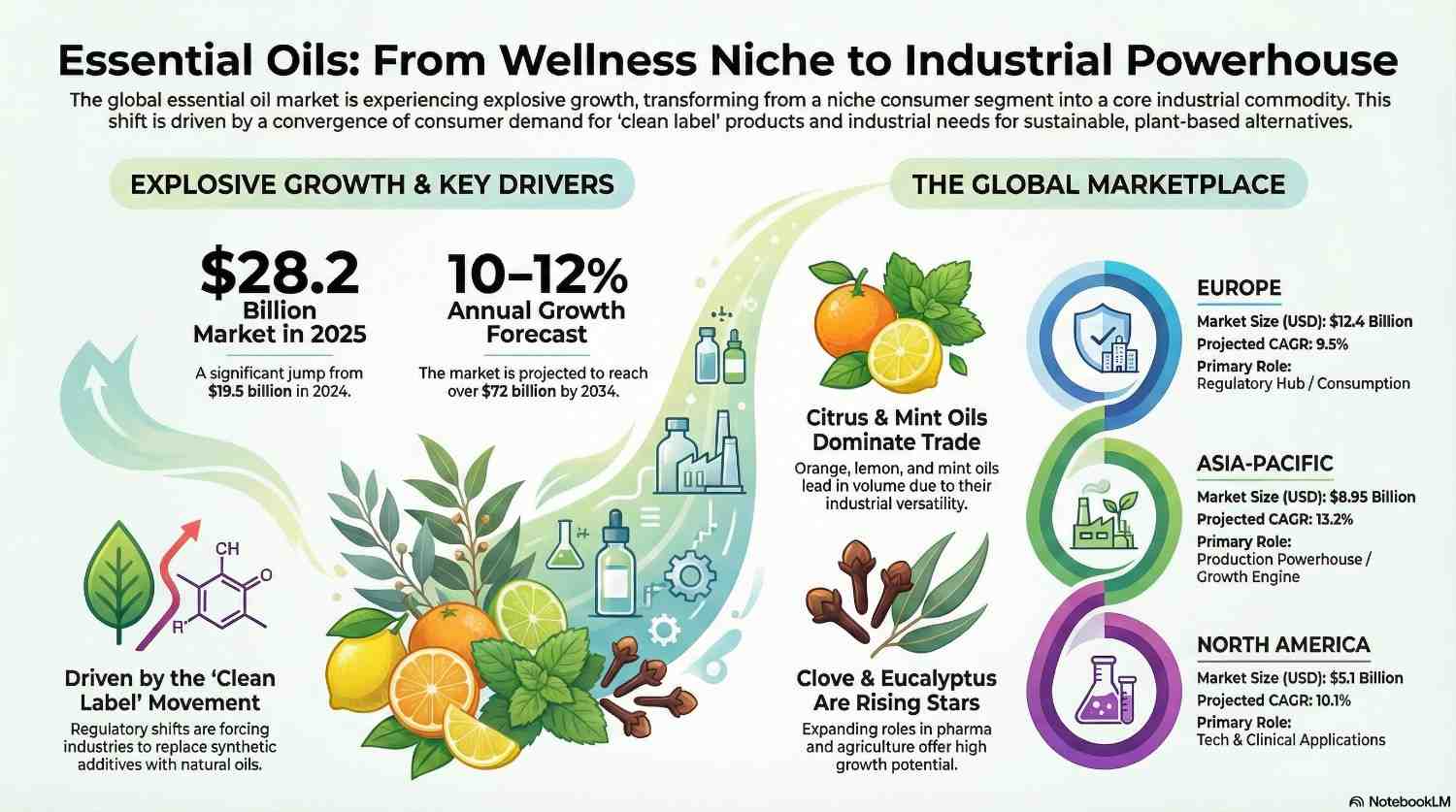
The global essential oil market has entered a phase of aggressive structural expansion. Between 2024 and 2025, the market valuation shifted from USD 19.5 billion to over USD 28.2 billion. This significant year-over-year jump reflects a post-pandemic recalibration of supply chains and the massive integration of essential oils into high-volume industrial sectors such as pharmaceuticals and clean-label food preservation.
Looking ahead, the market is projected to maintain a steady CAGR of 10–12%. Demand is primarily insulated by the "Clean Label" movement and a permanent shift toward natural wellness in mature economies. Europe remains the global leader in both consumption and regulatory standards, while the Asia-Pacific region serves as the primary engine for production and emerging demand. High-liquidity oils—specifically citrus (orange/lemon), mint, and eucalyptus—continue to dominate trade volumes due to their versatility in flavoring and therapeutic applications.
Key Market Drivers (2025 and Beyond)
|
Driver |
Impact on Demand |
End-Use Industries |
Supporting Indicators |
|
Natural Wellness & Clean-Label |
High |
F&B, Personal Care |
15% increase in "free-from" retail sales (Statista) |
|
Aromatherapy & Traditional Med. |
Moderate-High |
Healthcare, Spa/Wellness |
Rising import of therapeutic-grade oils in North America |
|
Cosmetic Reformulation |
High |
Skincare, Haircare |
EU ban on synthetic fragrance allergens (REACH 2025) |
|
Natural Preservation (F&B) |
Moderate |
Processed Foods, Dairy |
FAO data on antimicrobial plant-extract research |
>>> Top 20 Essential Oil Brands in the USA
- Analyst Commentary: The Clean-Label driver is no longer a marketing "extra" but a regulatory necessity in the EU and parts of North America. This has forced the Food & Beverage (F&B) sector to replace synthetic preservatives with essential oils like clove and rosemary. In the Cosmetics sector, the expansion of the EU's fragrance allergen list has triggered a mass-market shift toward essential oil-based scent profiles, driving massive volume orders for orange and lavender oils.
- Section Summary: Market growth is fundamentally anchored in regulatory shifts and a deep-seated consumer distrust of synthetic additives. These drivers ensure long-term demand stability despite potential price volatility in raw agri-commodities.
Market Size and Growth Forecast (2024–2034)
The following table outlines the projected market evolution. The CAGR is calculated using the formula:

Global Market Valuation (USD Million)
|
Year |
Conservative (10%) |
Optimistic (12%) |
Strategic Mid-Point |
|
2024 (Base) |
19,500 |
19,500 |
19,500 |
|
2025 (Est.) |
28,240 |
28,500 |
28,370 |
|
2027 |
34,170 |
35,750 |
34,960 |
|
2030 |
45,480 |
50,230 |
47,855 |
|
2034 |
66,580 |
79,050 |
72,815 |
>>> Top 10 Essential Oil Manufacturers and Suppliers
- Analyst Commentary: The acceleration between 2024 and 2025 is attributed to the "Green Industrialization" phase, where bulk industrial users locked in multi-year supply contracts to hedge against climate-related crop failures. From 2026 onwards, the growth rate is expected to moderate to a sustainable 10-12% as the market reaches a higher level of maturity. Conservative scenarios account for potential regulatory hurdles in the EU regarding "essential oil allergens," while optimistic scenarios assume a breakthrough in bio-pesticide applications.
- Section Summary: The market is on a trajectory to nearly triple in size over the next decade. The primary risk factor remains supply-side volatility, whereas the demand-side remains robust across all geographic segments.
Regional Analysis
|
Region |
2025 Size (USD M) |
Projected CAGR |
Primary Role |
|
Europe |
12,400 |
9.5% |
Regulatory Hub / Luxury Consumption |
|
Asia-Pacific |
8,950 |
13.2% |
Production Powerhouse / Growth Engine |
|
North America |
5,100 |
10.1% |
Tech-Aromatherapy / Clinical Applications |
|
Rest of World |
1,750 |
8.8% |
Raw Material Sourcing (Africa/LatAm) |
>>> Choose Right Bulk Essential Oils Supplier
- Analyst Commentary: Europe maintains its lead due to the high concentration of fragrance houses in France and Germany. However, Asia-Pacific is the region to watch; India and China are not just exporters anymore—their domestic cosmetic and pharmaceutical industries are consuming an increasing share of local production. North America is seeing a surge in "Clinical Aromatherapy," where oils are used as adjunct treatments in mental health and geriatric care.
- Section Summary: While Europe provides the market’s value, Asia-Pacific provides its momentum. Geographic diversification of sourcing (e.g., increasing clove production in Madagascar) is crucial for mitigating regional supply shocks.
Key Oils and Product-Level Demand
|
Oil Type |
Major Producers |
Primary Applications |
Trend (2025–2030) |
|
Orange/Lemon |
Brazil, USA, Italy |
F&B, Household Cleaners |
Bullish: Highest volume growth |
|
Mint Oils |
India, China |
Oral Care, Confectionery |
Stable: Steady industrial demand |
|
Eucalyptus |
China, Australia |
Pharma (Cough/Cold) |
Growing: Integrated in wellness |
|
Clove Oil |
Indonesia, Madagascar |
Dental Care, Food Pres. |
Bullish: Natural pesticide use |
>>> Biggest Exporter of Essential Oils
- Analyst Commentary: Citrus oils remain the market's "liquidity" backbone, largely because they are byproducts of the juice industry, making them cost-competitive for large-scale industrial use. Mint oils from India (Peppermint and Mentha Arvensis) are seeing price stability due to improved distillation efficiencies. Clove oil is experiencing a strategic pivot; beyond dental care, it is being tested as a natural alternative to synthetic fumigants in organic agriculture (ITC Trade Map).
- Section Summary: Citrus and Mint remain the "Safe Havens" for investors. Diversifying into Clove and Eucalyptus offers higher alpha potential due to their expanding roles in the pharmaceutical and agricultural sectors.
Trends and Emerging Opportunities
- Subscription-Based Models & Tech Integration - The direct-to-consumer (DTC) segment is evolving. We are moving away from one-off retail purchases toward subscription models that offer curated wellness kits. Simultaneously, Smart Aromatherapy (IoT-enabled diffusers) allows users to control dosage and scent profiles via mobile apps, creating a "locked-in" ecosystem for essential oil refills.
- Localized Formulations for Emerging Markets - As disposable income rises in Southeast Asia and Latin America, manufacturers are developing "localized" blends that incorporate regional scents (e.g., Lemongrass in Thailand, Sandalwood in India) to cater to cultural preferences while maintaining global quality standards.