
Choosing the Right Manufacturer for Your Skincare Brand

The single most defining decision you will make for your brand.
You have a vision. You see the product, the packaging, the customer reviews, and the market need. You’ve poured your heart into creating a skincare brand that you believe will change lives. But before your revolutionary moisturizer or serum can ever touch a customer's skin, it must be made.
This is where the journey gets real—and often, a little intimidating. Choosing the right skincare manufacturer is, without a doubt, one of the most defining decisions for your entire beauty brand.
It is more than just picking a factory to mix ingredients. Choosing the right manufacturer is like choosing a long-term creative partner. This partner will take your abstract, wonderful idea and transform it into a tangible product. They hold the power to dictate your product’s quality, your ability to scale, your profit margins, and, ultimately, your brand's reputation.
This process doesn't need to be overwhelming. You are the visionary, the leader, and the founder. You have the right to demand excellence and transparency. This guide is here to break down the technical steps into clear, human ideas, helping you feel confident and in control as you select the partner who will build your dream.
💡 How do you choose the right manufacturer for your skincare brand?
To choose the right manufacturer, define your product's ingredient philosophy and budget, then evaluate partners based on their specific expertise in your product category, formulation capabilities (private label vs. custom), production capacity, adherence to quality standards like GMP, and, most crucially, their communication and quality control processes. Treat the selection as a partnership, not just a transaction.
🔬 Understanding the Role of a Skincare Manufacturer
Before you evaluate potential partners, it helps to understand exactly what a skincare manufacturer (often called a skincare production partner) actually does. They are your brand’s comprehensive backstage team. They handle every technical step required to turn raw materials into a finished product ready for your customer.
In simple terms, their job includes:
- Product Development & Formulation: Taking your initial idea (e.g., "I want a gentle Vitamin C serum") and creating the precise recipe. This is the Research & Development (R&D) phase.
- Sourcing and Testing: Finding and testing all the raw ingredients and making sure they are safe, effective, and free of contaminants.
- Compliance and Regulation: Ensuring the product formula and labels meet the legal standards (like the FDA or EU regulations) for wherever you plan to sell.
- Production (Mixing & Filling): The actual manufacturing process—mixing the ingredients in large batches, and then accurately filling the product into your chosen bottles, jars, or tubes.
- Quality Control (QC): Checking every step of the process to ensure consistency, safety, and stability.
- Packaging: Assisting with or managing the sourcing and assembly of your primary packaging (the bottle) and secondary packaging (the box).
A manufacturer is the essential bridge between your brand vision and your customer’s vanity.
Cosmetics Manufacturer in Delhi NCR
✅ Key Factors to Consider When You Choose Skincare Manufacturer
When you start your search, every manufacturer will claim they are the best. Your job is to look past the marketing and evaluate them on concrete, human-friendly criteria.
-
Expertise and Experience: The Specialist Factor
You need a partner who has deep experience making the specific types of products you want to sell.
Metaphor: You wouldn't ask a baker to grill a steak; you'd go to a steakhouse chef. Similarly, if you want a complex, waterless balm, you need a manufacturer with a proven track record in anhydrous (water-free) formulations, not just one that specializes in simple lotions.
Ask about their portfolio: Have they worked with high-concentration actives (like retinoids or acids) before? Do they have experience with the unique challenges of natural preservatives? Specific experience lowers risk and speeds up development.
-
Formulation Capabilities: Private Label vs. Custom
This is a fundamental choice that impacts your brand’s uniqueness.
- Private Label (often called White Label): Think of this as choosing from a pre-set menu. The manufacturer has already created a stable, tested formula (e.g., a standard Hyaluronic Acid serum). You simply choose the formula, put your brand’s name and logo on it, and select a package. It’s faster, cheaper, and has a lower Minimum Order Quantity (MOQ).
- Custom Formulation (often called OEM/ODM): This is the bespoke option. You and the manufacturer’s R&D team work together to create a brand-new, unique formula from scratch, based on your specific ingredient list and desired results. It’s more expensive, takes much longer, but results in a product that no one else has.
You need a skincare production partner who offers the service level you require now and can potentially offer the other later as you grow.
-
Ingredient Philosophy: Your Recipe and Your Chef
The ingredients are the "recipe" of your brand; the manufacturer is the "chef" who executes it. Your partner must understand and respect your non-negotiable ingredient philosophy.
- Clean/Natural: A focus on ingredients derived from nature, often avoiding synthetic preservatives, fragrances, or certain chemical sunscreens.
- Organic: Requires the sourcing of ingredients that are certified organic, which demands specialized suppliers and documentation.
- Synthetic/Medical Grade: A focus on lab-created ingredients proven for efficacy (e.g., specific peptides, synthetic vitamins).
Ask: "Do you have separate processing lines or procedures to avoid cross-contamination if I require strict vegan or organic standards?" The answer will tell you if they truly understand your needs.
-
Certifications and Standards: Proof of Quality
These are not just fancy acronyms; they are proof that the manufacturer follows strict, global guidelines for safety and quality.
- GMP (Good Manufacturing Practices): This is the gold standard, often required by law. It means the facility follows a comprehensive system of procedures to ensure products are consistently produced and controlled according to quality standards. In simple terms, it means they run a clean, organized, and accountable operation.
- ISO (International Organization for Standardization): A set of global standards. ISO 22716 is the standard specific to cosmetics GMP.
- Cruelty-Free / Vegan: Certification from bodies like Leaping Bunny or The Vegan Society proves that they and their suppliers do not test finished products or raw materials on animals.
Look for a manufacturer who is open about their certifications and willing to show you documentation. This demonstrates confidence and transparency.
-
Production Capacity and Scaling: Growing Together
Startups often start small, but the goal is to grow. You need a partner who can support you now and five years from now.
Analogy: Startups need a partner who can grow with them, the way a good school supports you from primary to high school. If your current manufacturer can only produce 5,000 units a month, and you suddenly land a major retailer order for 50,000 units, they become a bottleneck that could kill your brand’s momentum.
Ask about their maximum output for your product type and what their strategy is for handling a sudden, large increase in orders.
-
Quality Control (QC) and Testing: The Taste Test
Quality Control is the manufacturer's job of checking the product at every stage to ensure it’s safe, consistent, and stable.
Comparison: Think of QC as the taste-testing before serving a meal. They are checking: Is the color right? Is the texture smooth? Is the pH level safe for the skin? Will it separate in the bottle over time?
A good partner will conduct essential tests:
- Stability Testing: Will the formula remain stable (no separation, color change, or texture change) in different temperatures and conditions over the product’s shelf life?
- Microbial/Preservative Efficacy Testing (PET): Does the product’s preservative system effectively kill bacteria, yeast, and mold that might be introduced during customer use?
Demand transparency in their QC process. They should provide documentation for all testing.
-
Lead Times and Communication: The Backbone of Trust
Lead time is the amount of time between you placing a firm order and the manufacturer delivering the finished goods. This can range from 8 to 20 weeks, or even longer for custom components.
Communication is the backbone of long-term success. If a manufacturer takes weeks to respond to a simple email during the negotiation phase, imagine how slow they will be when you have a production emergency. The best partners communicate clearly, proactively, and honestly about delays. They offer solutions, not just excuses.
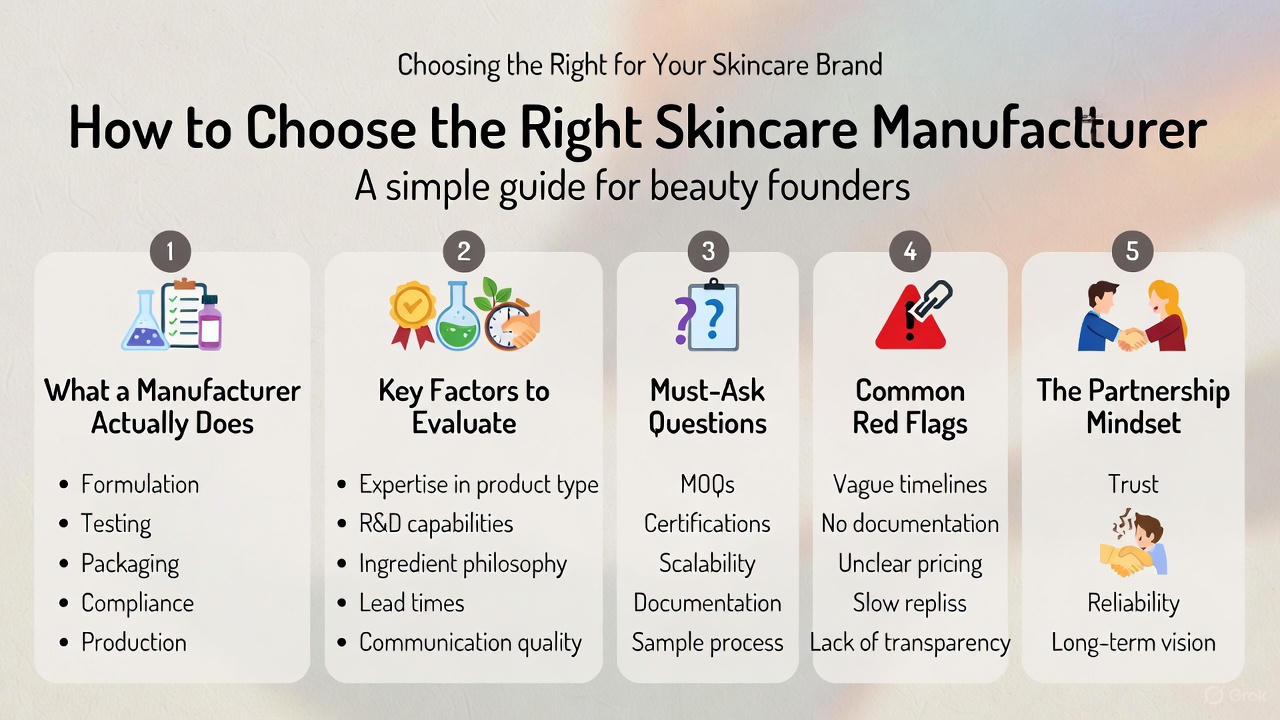
❓ 10 Essential Questions Every Brand Should Ask
Once you’ve narrowed down your list of potential private label skincare manufacturer or custom partners, here are the practical questions you need to ask during your first meetings:
- What is your Minimum Order Quantity (MOQ) for this specific product type? (The most critical factor for a new brand's budget).
- Can you provide a detailed, itemized cost breakdown (Cost of Goods Sold - COGS) for an initial run?
- What is your standard lead time for reorders versus an initial custom formulation order?
- Can you share case studies or references from other skincare brands you've worked with?
- What are your specific testing procedures (e.g., Stability) and which ones are included in the formulation fee?
- Are you certified for GMP and can you provide proof of this certification?
- What is the process for submitting new ideas, and what is your typical R&D timeline for a custom product?
- Can you support future product expansions, such as filling into airless pumps or non-standard packaging?
- What is your policy regarding ingredient sourcing? Do you use a restricted substance list?
- Who will be my dedicated project manager or main point of contact for day-to-day communication?
Top 10 Cosmetic Manufacturers in India 2025
🛑 Common Mistakes to Avoid
Even the most well-meaning founders can trip up in the search process. Avoid these pitfalls:
-
❌ Mistake : Chasing the Absolute Cheapest Price
A low COGS (Cost of Goods Sold) is attractive, but a rock-bottom price often means compromises in ingredient quality, formulation stability, or worker standards. Your product quality is your brand's reputation. Sacrificing quality to save a few pennies per unit is a false economy that will cost you more in the long run through returns, bad reviews, and lost customer trust.
-
❌Mistake : Ignoring Documentation and Contracts
Everything must be in writing. This includes your NDA (Non-Disclosure Agreement) to protect your ideas and your Supply Agreement which outlines price, quality standards, testing requirements, and liabilities. If a manufacturer is vague about providing signed, detailed documents, that is a massive red flag.
-
❌Mistake : Skipping or Rushing the Sampling Phase
Samples are not a formality—they are a crucial quality check. You must test the sample formula on yourself, share it with trusted testers, and let it sit on your shelf for a while. If the color or texture changes after a week, you need to know before you produce 5,000 units. Take your time and be hyper-critical.
Top Third Party Cosmetic Manufacturers in Ghaziabad
🤝 The Partnership Mindset: Beyond a Transaction
The most successful brands view their manufacturer not as a vendor, but as a critical collaborator.
Metaphor: Building a brand is a relay race—you need a partner who can run in sync with you. You run the marketing, branding, and sales leg; the manufacturer runs the technical, production, and quality assurance leg. If you drop the baton or run too fast for them, the race is over.
The best relationships are built on shared goals: your success is their success. Look for a partner who is proactively suggesting cost-saving efficiencies, advising you on regulatory changes, or even recommending new, exciting ingredients. This level of collaboration transforms your relationship into a powerful competitive advantage.
🚩 Red Flags You Must Heed
When you are exploring your options for a good skincare manufacturer, be on the lookout for these clear warning signs:
|
Red Flag |
What It Means for Your Brand |
|
Vague Timelines |
They constantly shift deadlines or say "it depends" without defining what it depends on. This leads to missed product launch dates. |
|
No Documentation |
They are unwilling to share their GMP certificate, quality control reports, or detailed ingredient specs. This signals a lack of accountability and transparency. |
|
Unclear Pricing Structure |
Quoting only a final price without breaking down costs (e.g., ingredients, labor, packaging, filling fees). This hides markups and makes it impossible to negotiate or understand your margins. |
|
Poor Communication |
Slow or hostile responses, failing to assign a dedicated contact, or repeatedly misunderstanding simple instructions. If it's bad now, it will be catastrophic in a crisis. |
|
Excessive Upfront Fees |
Demanding massive formulation fees or high deposits long before work has started, especially for a standard private label product. |
Cosmetic Manufacturer in Noida
💰 Budget, MOQs, and Hidden Costs
The conversation about money can feel daunting, but you must be clear and firm.
-
Understanding MOQs (Minimum Order Quantities)
Comparison: MOQs are like the minimum tickets you need to buy to enter a concert—non-negotiable, but they vary widely by venue. They exist because a manufacturer needs to make production worthwhile; it takes the same amount of effort (and machine downtime) to set up a batch run of 1,000 units as it does for 10,000.
- MOQs for private label (off-the-shelf formulas) are typically lower (e.g., 500 to 2,500 units).
- MOQs for custom formulation (brand-new formulas) are much higher (e.g., 5,000 to 10,000 units), as the cost of R&D and specialized sourcing needs to be spread over more units.
-
The Hidden Cost Checklist
Ask about all potential fees beyond the simple unit cost:
- R&D/Formulation Fee: The cost to create a new, unique recipe.
- Stability and PET Testing Fees: Often charged separately, these are non-negotiable for safety.
- Packaging Molds/Tooling: If you require a custom bottle shape or cap, there will be a one-time setup fee for the manufacturer to purchase the tooling.
- Freight and Import Duties: The cost to ship the finished goods from their facility to your warehouse.
A good partner will disclose these upfront.
📈 Why Choosing the Right Manufacturer Pays Off Long-Term
Taking the time to research, vet, and choose the right skincare production partner is the smartest investment you can make, and it pays dividends you can’t put a price on.
- Fewer Headaches: When quality control is high, you have fewer product returns, fewer customer complaints, and spend less time managing manufacturing issues.
- Better Quality and Safety: You build a reputation on product integrity, not just clever marketing. Customers trust a brand that consistently delivers a great, safe experience.
- Smoother Scaling: A partner with high capacity means you can aggressively pursue growth opportunities (like getting into major retail) without worrying if your production can keep up.
- Stronger Brand Reputation: In a saturated market, quality is the differentiator. Your manufacturer’s excellence becomes your brand’s excellence.
🏁 Conclusion: Trust Your Instincts, Trust the Data
The process of finding a skincare manufacturer may feel like a monumental task now, but remember: it is manageable when you break it down into logical, human steps. You are simply looking for a trustworthy, expert partner who is committed to executing your vision with the highest standards of safety and quality.
Start by defining your vision, ask the hard questions, demand transparency, and always test the product yourself. You are the founder, and your gut feeling matters. Combine your intuition with the concrete data you've gathered on their expertise and quality standards.
Select your partner thoughtfully, confidently, and collaboratively. Your future customers (and your future self) will thank you for it.
- Top 10 Cosmetic Manufacturers in Italy
- Top 10 German Cosmetic Manufacturers for Beginners
- Top 15 Cosmetics Manufacturers in the USA
- India Cosmetic Manufacturing Industry
- Cosmetic Third-Party Manufacturing in India
- Quality Control in Cosmetics: Best Practices for Manufacturers
- Indulging in Beauty: 8 Steps For Cosmetics Manufacturing Process
- Private Label vs. Contract Manufacturing : Cosmetic Industry
- Private Label Skin Care & Cosmetic Products Manufacturers in the World
- India vs Europe Cosmetic Regulations
- Private Label Cosmetic Company
- Top Private Label Cosmetic Industry India
- All About Cosmeceuticals in Skincare
❓ Frequently Asked Questions (FAQs)
- How do I start working with a skincare manufacturer? Begin by creating a detailed Product Brief outlining your target customer, product type (serum, lotion, etc.), desired results, key ingredients, and target price. Use this brief to request initial quotes and gauge their expertise. Start with 3–5 potential partners and vet them using the questions and standards outlined above.
- What is the difference between OEM and ODM in skincare? OEM (Original Equipment Manufacturing) means the manufacturer produces a product based on your exact, existing design and specifications. ODM (Original Design Manufacturing) means the manufacturer designs and formulates the product for you based on your brand’s idea and requirements, offering a more comprehensive, turn-key service that includes the R&D.
- How do I know if a manufacturer is reliable? A reliable manufacturer will be fully transparent and provide proof of their certifications (especially GMP), happily offer references from non-competing clients, disclose their Quality Control procedures, and maintain clear, proactive communication about lead times and potential issues. Reliability is proven through documentation and honesty.
- What documents should a manufacturer provide? You should always be provided with a Non-Disclosure Agreement (NDA), an itemized Quote/Cost Breakdown, a formal Supply Agreement, proof of Stability Testing, and a Certificate of Analysis (COA) for the finished product, confirming the batch meets specifications.
- What is a good MOQ for new skincare brands? For a brand launching its first line, a good MOQ (Minimum Order Quantity) for a private label product is often between 500 and 1,000 units per SKU (Stock Keeping Unit). For a truly custom formulation, MOQs often start higher, ranging from 3,000 to 5,000 units. Focus on finding the lowest volume that is financially sustainable for both parties.
Would you like me to find some industry associations or trade shows where you could begin your search for a reputable skincare manufacturer?