
10 Essential Oils to Not Use in Bath

When a customer draws a warm bath, they are looking for a moment of peace. They want to relax, breathe in a nice scent, and step out feeling refreshed. As a brand owner or a product manager, your goal is to provide that experience.
However, there is a hidden risk in the bath world that many brands overlook. Just because an oil is "natural" or "pure" does not mean it belongs in a bathtub. In fact, some of the most popular essential oils can cause real physical pain when mixed with hot water and full-body contact.
The issue usually starts in the formulation phase. Brands often add oils to bath salts, bombs, or oils because they smell great in a diffuser. But the skin on our bodies—especially in a hot bath—is very different from the air in a room. Hot water opens the pores and increases blood flow, which makes the skin much more sensitive.
In this guide, we will break down which oils you should avoid for bath products and why. If you are looking to build a private-label bath line, this knowledge will help you create a product that is both high-quality and safe.
Why Bath Safety Matters for OEM/ODM and Private-Label Brands
If you are a B2B buyer, safety is not just a health issue; it is a business strategy. One bad customer experience can lead to a wave of negative reviews that can sink a new product launch.
- Full-Body Contact: When someone uses a face cream, the product touches a small area. In a bath, the product touches almost every inch of the skin. This includes the most sensitive areas of the body. If an oil is an irritant, the reaction will be widespread and very uncomfortable.
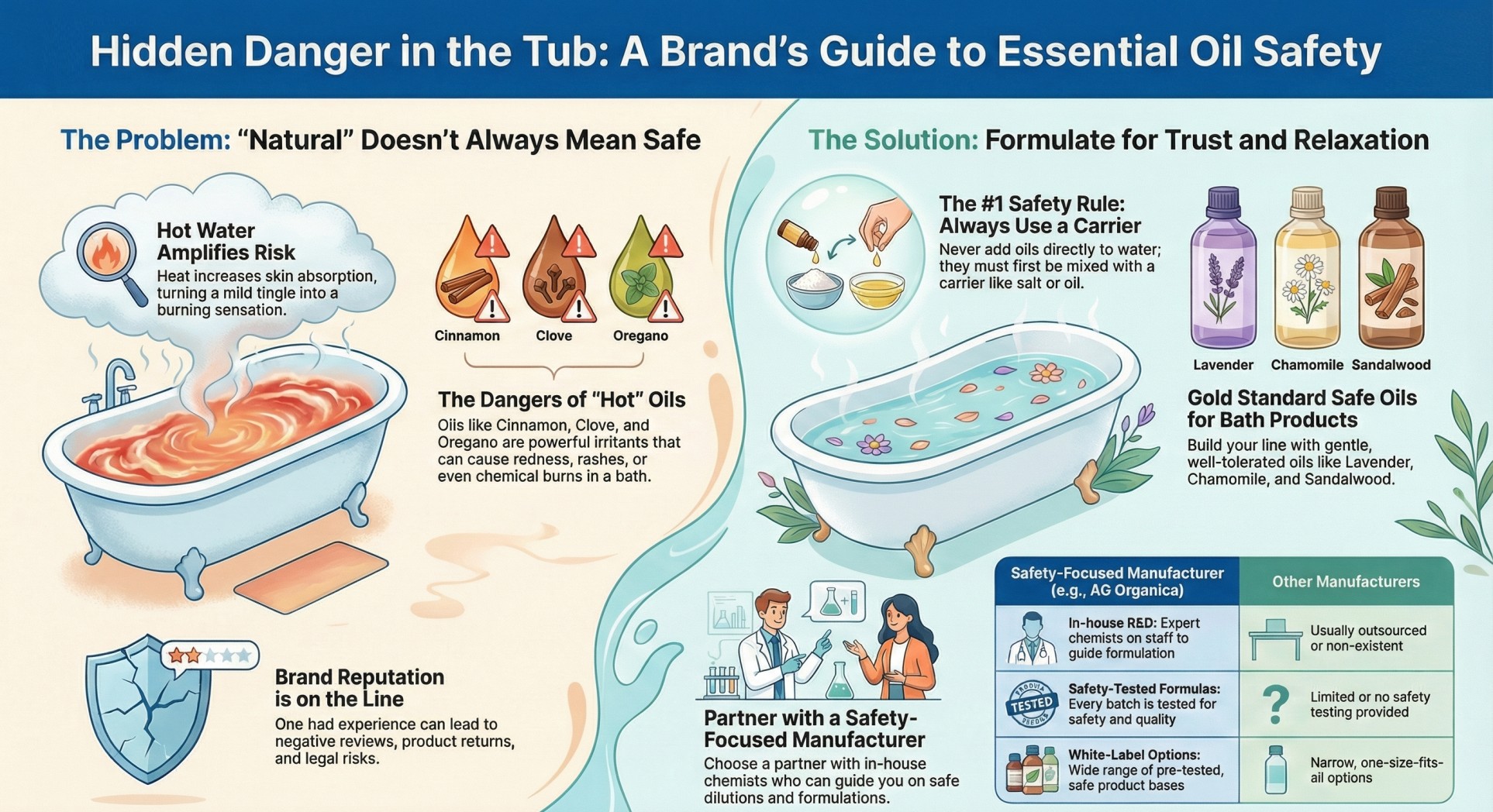
- Increased Absorption: Heat acts as a catalyst. Hot bath water increases the rate at which the skin absorbs ingredients. What might be a "mild tingle" in a cold lotion can become a "burning sensation" in a 40°C bath.
- Brand Reputation and Legal Risks: Unsafe formulas lead to returns. In worse cases, they lead to legal complaints or a damaged reputation with retailers. If you are selling to big stores, they will require safety data and proof that your formulas won't cause skin "sensitization."
- A short counterpoint: Brands often think "natural means safe," but this is not true. Poison ivy is natural, but you wouldn't put it in a bath. Essential oils are chemical powerhouses. Handling them requires respect and professional formulation.
10 Essential Oils You Should Never Use In Bath
Here are the oils that often cause trouble. If you are designing a white-label bath line, we recommend keeping these out of the water.
-
Cinnamon Oil (Bark or Leaf)
- Why it is unsafe: Cinnamon is a "hot" oil. It is a powerful skin irritant and a common allergen.
- The Issue: In a bath, it can cause redness, a burning feeling, and even a rash.
- Safer Alternative: Vanilla Oleoresin or Copaiba (for a warm, sweet scent).
- Best Used In: Room diffusers or very low concentrations in foot balms.
-
Clove Oil
- Why it is unsafe: Like cinnamon, clove is very high in eugenol. It is highly irritating to the mucous membranes.
- The Issue: It can cause a sharp stinging sensation on sensitive skin.
- Safer Alternative: Frankincense (for a spicy, deep aroma).
- Best Used In: Mouthwashes (very diluted) or cleaning products.
-
Oregano Oil
- Why it is unsafe: This is one of the strongest "caustic" oils. It is great for fighting germs but terrible for the skin.
- The Issue: It can actually cause chemical burns if the concentration is too high in hot water.
- Safer Alternative: Tea Tree (in very low doses) or Thyme Linalool (a much gentler version).
- Best Used In: Targeted herbal salves for the feet.
-
Thyme Oil (Thymol type)
- Why it is unsafe: Most Thyme oil is very high in thymol, which is aggressive on the skin.
- The Issue: It can cause skin sensitization, meaning the customer might develop a permanent allergy to it.
- Safer Alternative: Marjoram (it has a similar herbal scent but is much calmer).
- Best Used In: Household cleaners or chest rubs.
-
Wintergreen Oil
- Why it is unsafe: It is almost entirely methyl salicylate (similar to liquid aspirin).
- The Issue: It is absorbed too quickly in a hot bath, which can be toxic in large amounts, especially for children.
- Safer Alternative: Pine or Fir Needle oil (for that fresh, forest scent).
- Best Used In: Targeted muscle rubs for small areas like a sore knee.
-
Peppermint Oil
- Why it is unsafe: This is a surprising one. While it smells fresh, the high menthol content creates a "cold-burn" sensation.
- The Issue: In a bath, it can make the user feel uncomfortably cold and shaky, or it can sting sensitive areas.
- Safer Alternative: Spearmint (it is much milder) or Eucalyptus Radiata.
- Best Used In: Foot scrubs or lip balms.
-
Basil Oil
- Why it is unsafe: Certain types of Basil oil are high in methyl chavicol, which can be irritating.
- The Issue: It is often a "sensitizer," causing the skin to react even in small amounts.
- Safer Alternative: Lavender or Sweet Marjoram.
- Best Used In: Diffusers for focus and clarity.
-
Lemongrass Oil
- Why it is unsafe: It has a very high citral content.
- The Issue: Citral is a well-known skin irritant in leave-on and bath products.
- Safer Alternative: May Chang (Litsea Cubeba) or Geranium (for a floral-citrus mix).
- Best Used In: Natural insect sprays or room mists.
-
Savory Oil
- Why it is unsafe: Similar to Oregano, it is a "hot" oil filled with phenols.
- The Issue: It is simply too aggressive for full-body immersion.
- Safer Alternative: Rosemary (in low doses) or Cedarwood.
- Best Used In: Specific herbal soaps where it is rinsed off quickly.
-
Camphor Oil
- Why it is unsafe: It is very powerful and can affect the nervous system if absorbed in high amounts through the skin.
- The Issue: It can cause dizziness or skin numbness in a hot bath.
- Safer Alternative: Cedarwood or Cypress (for an earthy, woody scent).
- Best Used In: Targeted ointments for bruises or sprains.
Safer Essential Oils for Bath Products
If you want to create a relaxing bath line, these oils are the "gold standard." They are generally well-tolerated and provide the relaxation customers crave.
- Lavender: The ultimate bath oil. Calm, safe, and universally loved.
- Chamomile (Roman or German): Excellent for soothing dry or itchy skin.
- Frankincense: Deep, resinous, and very gentle on the skin.
- Sandalwood: Provides a luxury, woody scent without the irritation of "hot" woods.
- Vanilla Oleoresin: Adds a comforting, sweet note that is very safe.
- Geranium: A beautiful floral that helps balance the skin’s oils.
- Rose: The height of luxury. It is gentle, soothing, and smells incredible.
Product Ideas for White-Label Bath Lines (Safe, Scalable, and High-Demand)
Using these safe oils, you can build a diverse product range. Here are a few ideas that work well for private label brands:
- Relaxing Bath Oils: A blend of Fractionated Coconut Oil and Lavender. These are popular because they moisturize the skin while the customer soaks.
- Mineral-Rich Bath Salts: Using Dead Sea or Himalayan salt infused with Chamomile and Bergamot (FCF-free).
- Creamy Bath Soaks: A liquid "milk" soak using oats and Sandalwood oil. These are great for the "clean beauty" market.
- Shower Oils: For people who don't have a tub. These are applied to wet skin and turn into a milky lotion.
- Spa Gift Sets: A combination of a bath salt, a safe candle, and a body oil. These are top sellers during the holiday season.
Packaging Trends B2B Brands Should Watch
Your packaging tells the customer if the product is safe before they even open it. Here is what is working in 2026:
- Minimal Pastel Colors: Soft greens, blues, and pinks suggest a "gentle" and "calm" experience.
- Amber PET Bottles: These look like glass but are safe for the bathroom (they won't shatter if dropped). The dark color protects the oils.
- Frosted Glass: For high-end serums or bath oils, frosted glass looks and feels expensive.
- Eco-Refill Pouches: Many customers now want to reuse their glass jars. Offering a "refill" is a great way to increase loyalty.
- QR-Based Transparency: Put a QR code on the label. When scanned, it shows the "Safety Report" and explains why the specific oils were chosen.
Comparison Chart – AG Organica vs. Other Bulk Manufacturers
|
Feature |
AG Organica |
Other Manufacturers |
|
In-house R&D |
Yes, expert chemists |
Usually no / Outsource |
|
Safety-tested formulas |
Yes, every batch |
Limited or None |
|
White-label options |
Wide range of safe bases |
Narrow / One-size-fits-all |
|
OEM/ODM capacity |
Strong, custom solutions |
Moderate / Generic only |
|
Global export support |
Yes, full documentation |
Limited / Local only |
|
Eco packaging |
Available and Trending |
Rare / Hard to source |
Why Working With AG Organica Helps You Avoid Safety Risks
Choosing the right manufacturer is the best way to protect your brand. At AG Organica, we don't just "fill bottles." We act as your safety consultant.
- We guide clients on safe formulations. If you come to us with an idea that includes a "hot" oil for a bath, we will tell you. We suggest safer alternatives that give the same scent but keep your customers safe.
- We test each batch. Quality control is our priority. We make sure the essential oils are pure and the dilution is exactly where it needs to be for a safe, pleasant experience.
- Custom Packaging and Support. We help you choose the right containers that won't react with the essential oils. We ensure your product looks as good as it performs.
How to Brief Your Contract Manufacturer the Right Way
When you contact a manufacturer like AG Organica, being clear will save you time and money. Use this checklist:
- State the Intended Use: Clearly say, "This oil blend is for a full-body bath soak."
- Define Skin Standards: Request that the formula be "suitable for sensitive skin" or "dermatologically tested."
- Ask for Dilution Advice: Ask the chemist, "What is the safest percentage of this oil for a 20-minute soak?"
- Request Allergen Reports: Make sure you have the list of allergens (like Citral or Linalool) for your labels.
- Start Small: Always request a sample batch to test the "skin feel" before committing to a massive order.
FAQ Section
- Can I put essential oils directly in bath water? No. Oil and water do not mix. If you drop neat oil into water, it will float on top in a concentrated bead. When that bead touches the skin, it is like applying the oil undiluted. Always mix it with a "carrier" like salt or liquid oil first.
- Which oils are safest for bath use? Lavender, Chamomile, and Frankincense are among the safest and most popular.
- Why are some oils unsafe even if they are natural? Nature is full of powerful chemicals. "Natural" does not mean "non-reactive." Some plants produce oils to protect themselves from insects; those same chemicals can be too strong for human skin.
- How does dilution affect safety? Dilution spreads the essential oil molecules across a larger base. This lowers the "dose" the skin receives, making the experience pleasant instead of painful.
- Can private-label brands sell bath oils worldwide? Yes, as long as you have the right safety documentation (like COA and MSDS). Working with an experienced exporter like AG Organica makes this process much easier.
Conclusion
In the competitive world of bath and body care, your brand is only as strong as your customers' trust. Safe formulas build that trust. Using "hot" or irritating oils in a bath product is a risk that simply isn't worth taking.
By choosing safe, effective essential oils and working with a manufacturer that prioritizes R&D, you can build a successful, scalable, and respected product line.